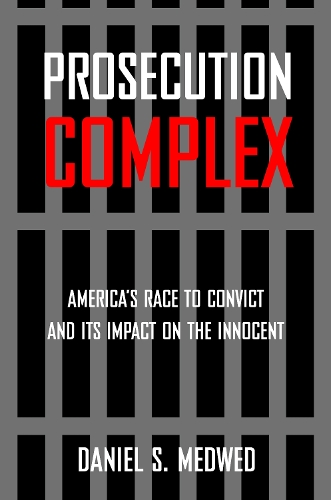
Книга Prosecution Complex: America's Race to Convict and Its Impact on the Innocent
Shows how, while most prosecutors aim to do justice, only some hit that target consistently.
American prosecutors are asked to play two roles within the criminal justice system: they are supposed to be ministers of justice whose only goals are to ensure fair trials—and they are also advocates of the government whose success rates are measured by how many convictions they get. Because of this second role, sometimes prosecutors suppress evidence in order to establish a defendant’s guilt and safeguard that conviction over time.
In Prosecution Complex, Daniel S. Medwed shows how prosecutors are told to lock up criminals and protect the rights of defendants. This double role creates an institutional “prosecution complex” that animates how district attorneys’ offices treat potentially innocent defendants at all stages of the process—and that can cause prosecutors to aid in the conviction of the innocent. Ultimately, Prosecution Complex shows how, while most prosecutors aim to do justice, only some hit that target consistently.
"Prosecution Complexchallenges us all to work towards changes that can be more likely to result in genuine justice, rather than the comfortable feeling that comes simply from putting somebody behind bars." - City Weekly
"Prosecution Complexis an enlightening book that tackles an issue many tend to shy away from." - Desert News
"The book should be required reading by all prosecutors, and by all law students who would seek to practice criminal law." - Los Angeles Daily Journal
"One value of Medwed's book is his even-handed, clear-headed explication of all the ways prosecutors can contribute to the conviction of innocent defendants. There is also value in his suggested reforms." - Rutgers
"Highly recommended for general readers, upper-division undergraduate students and above." - CHOICE
"Daniel S. Medwed has put together a book that appeals to both academics and anyone interested in gaining knowledge about many of the intricate details of prosecution." - Criminal Justice Review
"Medweds discussion of particularly horrific cases of injustice and particularly groundbreaking reforms is illuminating . . . [The author] reminds his readers that the goal of doing justice and achieving accurate outcomes is not hopelessly naive, nor is it necessarily an issue about which the defense and the prosecution should disagree. For better or worse, he also seems to suggest that much of the potential for reforming prosecutorial practices lies with prosecutors own commitment to doing honorable work." - Appeal and Habeas blog
"Medwed engages in a scholarly conversation with those who, like him, work or have worked in the criminal justice system and understand how seemingly small legal changes can seriously affect how cases are tried, won, and lost" - Boston Review