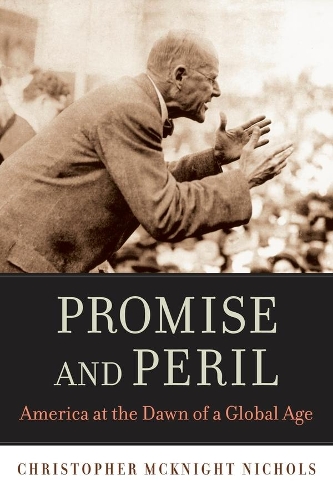
Книга Promise and Peril: America at the Dawn of a Global Age
Spreading democracy abroad or taking care of business at home is a tension as current as the war in Afghanistan and as old as America itself. Tracing the history of isolationist and internationalist ideas from the 1890s through the 1930s, Nichols reveals unexpected connections among individuals and groups from across the political spectrum who developed new visions for America’s place in the world.
From Henry Cabot Lodge and William James to W. E. B. Du Bois and Jane Addams to Randolph Bourne, William Borah, and Emily Balch, Nichols shows how reformers, thinkers, and politicians confronted the challenges of modern society—and then grappled with urgent pressures to balance domestic priorities and foreign commitments. Each articulated a distinct strain of thought, and each was part of a sprawling national debate over America’s global role. Through these individuals, Nichols conducts us into the larger community as it strove to reconcile America’s founding ideals and ideas about isolation with the realities of the nation’s burgeoning affluence, rising global commerce, and new opportunities for worldwide cultural exchange. The resulting interrelated set of isolationist and internationalist principles provided the basis not just for many foreign policy arguments of the era but also for the vibrant as well as negative connotations that isolationism still possesses.
Nichols offers a bold way of understanding the isolationist and internationalist impulses that shaped the heated debates of the early twentieth century and that continue to influence thinking about America in the world today.
"Just what did isolationists think—and say—in the early twentieth century? Christopher Nichols provides some provocative answers to that question in Promise and Peril, which is far more intellectually venturesome than its textbookish title suggests. Nichols has written a rediscovery of the isolationist tradition, a thorough and timely account of thinkers as diverse as William James, W. E. B. Du Bois, Randolph Bourne, Eugene Debs and Jane Addams… Nichols has accomplished a major feat, demonstrating that isolationism was a far richer and more complex intellectual tradition than its critics have ever imagined—one that still speaks to our own time, freshening the stale formulas of the Washington consensus and allowing us to reimagine the role of the United States in the world." - The Nation
"Christopher McKnight Nichols has written an outstanding intellectual history of isolationism… Nichols does an extraordinary job of conceptual exegesis… What is most fascinating about Promise and Peril is Nichols’ ability to communicate not only the intellectual and political contestation over ‘the meaning of America’ that occurred publicly, but also how this contestation occurred in the ‘hearts and minds’ of individuals as they struggled to integrate traditional ideas with novel circumstances." - New Global Studies
"This is an important book that broadens the context of turn-of-the-century isolationist thought and the domestic politics of American foreign relations. Most fundamentally, it demands that historians take isolationism more seriously than we have hitherto. Nichols provocatively prompts us to see it not as a limited and reactive political movement of 1919–20 or of the 1930s, but rather as a malleable and evolving intellectual and political tradition… Nichols has produced a very fine book that should reopen discussion of American isolationism. He deserves a round of applause. Promise and Peril should be widely read." - Journal of American Studies
"This is a thoughtful and important contribution to the intellectual history of U.S. foreign relations and to scholarly understanding of the forces shaping a broader U.S. international engagement in the twentieth century." - American Historical Review
"[A] highly perceptive work… Promise and Peril is a provocative study, demolishing many stereotypes and offering new patterns concerning liberal anti-interventionism. It deserves a wide readership." - H-Net
"In this important new book, Christopher McKnight Nichols invites a broad reconsideration of [isolationism] by tracing its origins back to the debates over U.S. imperialism at the end of the 19th century and its surprising continuities—and surprising bedfellows—over the next-half century… Nichols has done us a valuable service in providing us with tools to see history anew—and to wield it responsibly." - History News Network
"Americans are always on the lookout for isolationism in the U.S.—and it never arrives. In a most clearly explicated expose, Nichols explains why. Using the bio-historical approach, he brings forth salient figures from the Gilded Age to serve as examples to elucidate the nuances of the U.S.’s complex ideology. The author refutes prior simplistic assessments of George Washington and Thomas Jefferson’s ‘no entangling alliances’ descriptor of U.S. foreign policy, shifting the focus from isolationism to ‘meaningful international involvement (where) nothing less than the meaning of America was at stake.’ Through the voices often articulators of isolationist thinking, Nichols convincingly concludes ‘American policy in the interwar era was not nearly as isolationist as many have characterized it.’ Rather, these individuals proposed a ‘salvific prescription to reconstitute a better society’ in the midst of turbulent times. Clarifying the strains of isolationism serves as a useful tool for understanding the nuanced argument of Gilded Age thought prescient at the dawn of a new global age. Beneath the study of isolationist thought, Nichols reawakens a discourse of what it means to be an American." - Choice