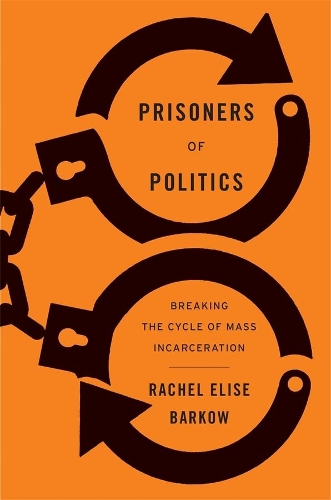
Книга Prisoners of Politics: Breaking the Cycle of Mass Incarceration
America’s criminal justice policy reflects irrational fears stoked by politicians seeking to win election. A preeminent legal scholar argues that reform guided by evidence, not politics and emotions, will reduce crime and reverse mass incarceration.
The United States has the world’s highest rate of incarceration, a form of punishment that ruins lives and makes a return to prison more likely. As awful as that truth is for individuals and their families, its social consequences—recycling offenders through an overwhelmed criminal justice system, ever-mounting costs, unequal treatment before the law, and a growing class of permanently criminalized citizens—are even more devastating. With the authority of a prominent legal scholar and the practical insights gained through on-the-ground work on criminal justice reform, Rachel Barkow explains how dangerous it is to base criminal justice policy on the whims of the electorate, which puts judges, sheriffs, and politicians in office. Instead, she argues for an institutional shift toward data and expertise, following the model used to set food and workplace safety rules.
Barkow’s prescriptions are rooted in a thorough and refreshingly ideology-free cost–benefit analysis of how to cut mass incarceration while maintaining public safety. She points to specific policies that are deeply problematic on moral grounds and have failed to end the cycle of recidivism. Her concrete proposals draw on the best empirical information available to prevent crime and improve the reentry of former prisoners into society.
Prisoners of Politics aims to free criminal justice policy from the political arena, where it has repeatedly fallen prey to irrational fears and personal interest, and demonstrates that a few simple changes could make us all safer.
"[An] important new book." - New York Times
"Barkow’s analysis suggests that it is not enough to slash police budgets if we want to ensure lasting reform. We also need to find ways to insulate the process from political winds. She urges that we entrust more criminal justice policy to experts, who overwhelmingly agree that the system is too harsh and too bloated. We don’t leave the regulation of air pollution or workplace conditions to a popular vote, she argues, so why should we do so with respect to public safety?" - New York Review of Books
"Making criminal law more reasonable is a stiff challenge in this era of fear-mongering politics. The challenge is even stiffer with the fear-mongering tied to fact-mocking. The spotlight Barkow shines on the facts and their implications will surely stir denial, but if the country does not meet the challenge, all of us will be less safe." - American Scholar
"Excellent analysis… Barkow argues for a multifaceted approach to reform… Readers interested in criminal justice reform will find much to appreciate here." - Publishers Weekly
"[A] crisply written, thorough book…Barkow paints a damning picture…laying out the voluminous evidence that mass incarceration is cruel and self-defeating…[She] convincingly shows that it has not made the American public safer." - Public Books
"An invaluable resource for those studying or addressing mass incarceration and/or wrongful convictions." - Choice
"[An] extremely efficient guide to our current problems…[A] rich but pointed survey of the maladies in our criminal justice system." - Criminal Law and Criminal Justice Books