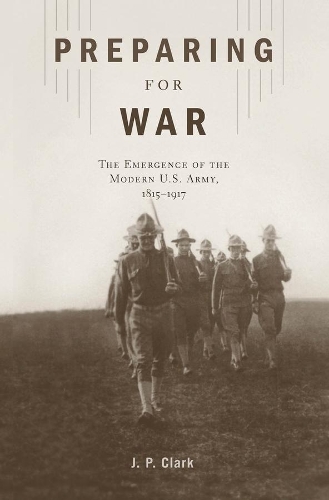
Книга Preparing for War: The Emergence of the Modern U.S. Army, 1815–1917
The U.S. Army has always regarded preparing for war as its peacetime role, but how it fulfilled that duty has changed dramatically over time. J. P. Clark traces the evolution of the Army between the War of 1812 and World War I, showing how differing personal experiences of war and peace among successive generations of professional soldiers left their mark upon the Army and its ways.
Nineteenth-century officers believed that generalship and battlefield command were more a matter of innate ability than anything institutions could teach. They saw no benefit in conceptual preparation beyond mastering technical skills like engineering and gunnery. Thus, preparations for war were largely confined to maintaining equipment and fortifications and instilling discipline in the enlisted ranks through parade ground drill. By World War I, however, Progressive Era concepts of professionalism had infiltrated the Army. Younger officers took for granted that war’s complexity required them to be trained to think and act alike—a notion that would have offended earlier generations. Preparing for War concludes by demonstrating how these new notions set the conditions for many of the successes—and some of the failures—of General Pershing’s American Expeditionary Forces.
"Magnificent…Clark shows us how history ought to be written—not only illuminating the past but providing a useful way to think about the future…The implication of Preparing for War is that although the Army—or any organization—can learn from past generational conflicts, there are limits to what it can do about those of the future." - National Review
"The alternating and overlapping tumult of innovation and inertia, centralization and dispersion is the fascinating story of Clark’s volume, one that documents the century-long shift from the concept of the innate warrior to that of the trained careerist. Clark is acutely aware of the very real difference between practical and theoretical skills in conflict, and that soldiers with expertise in one domain are often incompetent in the other…Conflict, of course, is the only final exam that matters. In the meantime, military organization and preparation remain intrinsically difficult, put to the test only on wildly disparate, sporadic occasions. It’s a problem the Army grappled with well into its formative years, one whose origins Clark cogently illuminates." - HistoryNet
"Clark adds to our understanding by focusing specifically on the evolving debates over how the Army should prepare for war…Clark delivers a solidly researched, carefully argued, and strongly written study that weaves a masterful synthesis of a hundred years of institutional and intellectual history…This is an important book, one filled with insights valuable for our own day." - The Strategy Bridge