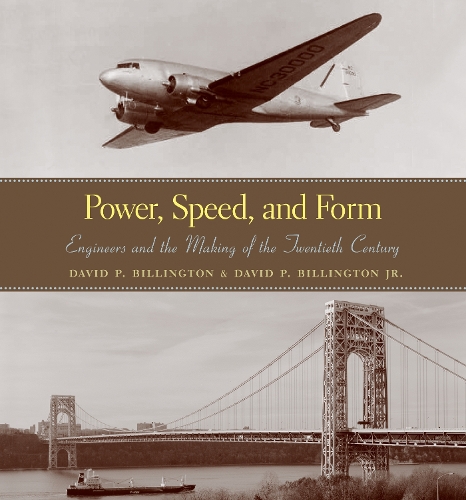
Книга Power, Speed, and Form: Engineers and the Making of the Twentieth Century
Power, Speed, and Form is the first accessible account of the engineering behind eight breakthrough innovations that transformed American life from 1876 to 1939—the telephone, electric power, oil refining, the automobile, the airplane, radio, the long-span steel bridge, and building with reinforced concrete. Beginning with Thomas Edison's system to generate and distribute electric power, the authors explain the Bell telephone, the oil refining processes of William Burton and Eugene Houdry, Henry Ford's Model T car and the response by General Motors, the Wright brothers' airplane, radio innovations from Marconi to Armstrong, Othmar Ammann's George Washington Bridge, the reinforced concrete structures of John Eastwood and Anton Tedesko, and in the 1930s, the Chrysler Airflow car and the Douglas DC-3 airplane.
These innovations used simple numerical ideas, which the Billingtons integrate with short narrative accounts of each breakthrough—a unique and effective way to introduce engineering and how engineers think. The book shows how the best engineering exemplifies efficiency, economy and, where possible, elegance. With Power, Speed, and Form, educators, first-year engineering students, liberal arts students, and general readers now have, for the first time in one volume, an accessible and readable history of engineering achievements that were vital to America's development and that are still the foundations of modern life.
"The authors discuss eight transformative inventions . . . within their sociocultural context. They also examine the lives of the inventors as well as the cumulative process of invention. The superb figures . . . and many photos nicely illustrate the Billingtons' overriding themes: the importance of technological literacy and the fact that original engineering is based on simple ideas." - Library Journal
"By introducing the fundamental theories upon which various significant technological achievements are based, Billington Sr. . . . and Billington Jr. . . . shed light on the unseen foundations of invention. . . . A remarkable accomplishment of this book is that it presents these theories and equations in a manner that is understandable to general readers, rather than accessible only to engineers or scientists. Thus, it fills a much-needed role in helping to enhance technological literacy and understanding among the general public. . . . Highly recommended." - Choice