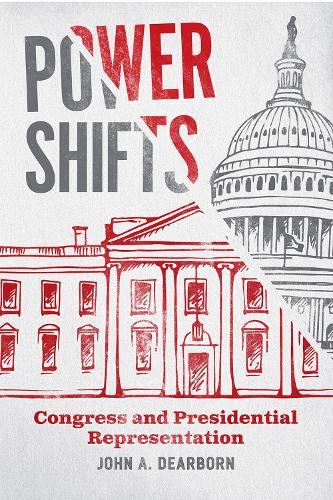
Книга Power Shifts: Congress and Presidential Representation
The emergence of the modern presidency in the first half of the twentieth century transformed the American government. But surprisingly, presidents were not the primary driving force of this change—it was Congress. Through a series of statutes, lawmakers endorsed presidential leadership in the legislative process and augmented the chief executive’s organizational capacities. But why did Congress grant presidents this power? In Power Shifts, John A. Dearborn shows that legislators acted on the idea of presidential representation. Congress subordinated its own claims to stand as the nation’s primary representative institution and designed reforms that assumed the president, selected by the country rather than states or districts, was the superior steward of national interest. In the process, Congress recast the nation’s chief executive as its chief representative. As Dearborn demonstrates, the full extent to which Congress’s reforms rested on the idea of presidential representation was revealed when that notion’s validity was thrown into doubt. In the 1970s, Congress sought to restore its place in a rebalanced system, but legislators also found that their earlier success at institutional reinvention constrained their efforts to reclaim authority. Chronicling the evolving relationship between the presidency and Congress across a range of policy areas, Power Shifts exposes a fundamental dilemma in an otherwise proud tradition of constitutional adaptation.
"This is a propulsive book. . . and Dearborn keeps the reader engaged through fascinating details about legislation that Congress passes in the midst of the 20th century that not only sets up policy outcomes but also provides the president with the power to create those outcomes." - New Books Network
"In Power Shifts, John Dearborn provides a very insightful, persuasive, and engaging account of some of the most important congressional activity of the 20th century–namely, legislative efforts to expand or rein in presidential authority and capacity in key policy areas. . . . Through a well-developed argument and an excellent qualitative research design, Dearborn shows that these institutional changes were shaped by prevailing ideas about presidential and congressional decision-making. . . . Dearborn marshals a remarkable array of evidence, including hundreds of contemporaneous statements by members of Congress and opinion leaders, to show convincingly that ideas have shaped the development of the institutional presidency and the power of the two branches." - Congress & the Presidency
"Power Shifts: Congress and Presidential Representation is an ambitious and impressive exploration of 'presidential representation,' the idea that the president will lead in a manner that is best for the entire country because the president represents the whole nation... Throughout the book, Dearborn revisits major congressional policy choices and explains what role presidential representation may have played. He consults a wide range of evidence to support his arguments,
including archival documents from several collections." - Political Science Quarterly
"In his remarkable book, Dearborn provides copious primary source evidence to support his thesis, and each of the case studies presents new and important information for understanding one major facet of the expansion of presidential power." - Perspectives on Politics
"John A. Dearborn’s Power Shifts is one of the best books on American political development that I have read in a very long time. His research is well-written, meticulous, and keenly sensitive to the kind of historical and documentary evidence necessary to support his causal claims that the major reforms of the presidency in the 20th century were a function of the power of an idea, presidential representation. Power Shifts goes beyond telling a good story; it is social science at its best. I recommend this book to all interested in American political development, the presidency, the power of ideas, and representation theory; quite a broad audience." - Party Politics
"Dearborn provides a very insightful, persuasive, and engaging account of some of the most important congressional activity of the 20th century. Through a well-developed argument and an excellent qualitative research design, Dearborn shows that these institutional changes were shaped by prevailing ideas about presidential and congressional decision-making." - Congress & The Presidency