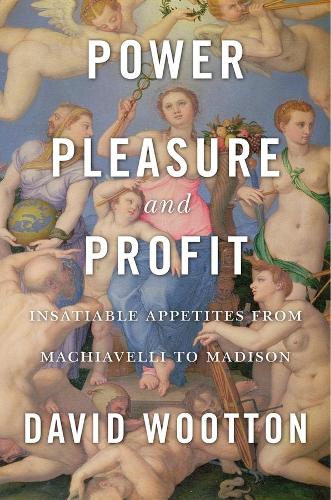
Книга Power, Pleasure, and Profit: Insatiable Appetites from Machiavelli to Madison
A provocative history of the changing values that have given rise to our present discontents.
We pursue power, pleasure, and profit. We want as much as we can get, and we deploy instrumental reasoning—cost-benefit analysis—to get it. We judge ourselves and others by how well we succeed. It is a way of life and thought that seems natural, inevitable, and inescapable. As David Wootton shows, it is anything but. In Power, Pleasure, and Profit, he traces an intellectual and cultural revolution that replaced the older systems of Aristotelian ethics and Christian morality with the iron cage of instrumental reasoning that now gives shape and purpose to our lives.
Wootton guides us through four centuries of Western thought—from Machiavelli to Madison—to show how new ideas about politics, ethics, and economics stepped into a gap opened up by religious conflict and the Scientific Revolution. As ideas about godliness and Aristotelian virtue faded, theories about the rational pursuit of power, pleasure, and profit moved to the fore in the work of writers both obscure and as famous as Hobbes, Locke, and Adam Smith. The new instrumental reasoning cut through old codes of status and rank, enabling the emergence of movements for liberty and equality. But it also helped to create a world in which virtue, honor, shame, and guilt count for almost nothing, and what matters is success.
Is our world better for the rise of instrumental reasoning? To answer that question, Wootton writes, we must first recognize that we live in its grip.
"Explains how European thought came to abandon the old virtues and accept the ‘selfish system’ of utility…Wootton explicates complex social and political theories with admirable lucidity." - Wall Street Journal
"More relevant to our current political and cultural circumstance than any other I’ve read in the last four years…Truly wonderful." - The World in Time
"Wootton presents the conceptual shift that gave birth to our life today in a book that is ambitious and impressive in its sweep…A gripping story of how ideas can change the world." - New Statesman
"Wootton does not wish to take sides in the controversy between detractors and defenders of the Enlightenment: his purpose is rather to retrace the emergence of the intellectual and cultural revolution that radically transformed modern Western societies… Power, Pleasure, and Profit is an erudite book, full of learned asides." - Times Literary Supplement
"This is decidedly not a traditional history of the Enlightenment as a philosophical or political project…Wootton’s Enlightenment ushered in a moral universe of unstoppable excess—one in which the pursuit of power, pleasure, and profit had no limit, for individuals or for societies…An unusual but fascinating foray into all the great themes of moral and political philosophy, from happiness to politics to commerce to love." - Commonweal
"His erudition is impressive and his range of inquiry is vast… Wootton traces the development of three interrelated notions that together, in his view, displaced the moral and religious inheritance bequeathed by classicism and Christianity." - Literary Review
"Gripping…A fascinating story…The Enlightenment spawned a series of assumptions about what human beings are, why they do what they do, and what the good life looks like. We’re still hostage to those assumptions, whether we know it or not, and Wootton’s book asks us to consider the consequences." - Vox
"In the brilliant, penetrating and amazingly erudite study by David Wootton…readers are treated to an engaging tour of the ‘Enlightenment paradigm’ gaining in the process a more profound understanding of our modern political economy and ethical situation…This book is essential reading for understanding the climate in which we still live and which is exported worldwide through neoliberalism and globalization." - Wall Street International
"Wootton’s notion of modest, practical Aristoteilian-esque virtue in the face of limitless appetite is a compelling one, and he stakes his claims methodically and persuasively." - The Millions
"Through the writings of great thinkers, Wootton describes the birth of a new concept of human nature during the years 1500 to 1800… Wootton demonstrates a consistent ability to make complex intellectual ideas approachable… A surprisingly lucid examination of a dramatic revolution in human thought." - Kirkus Reviews
"Valuable as a wide-ranging…investigation into the philosophical revolution that made the modern Western world." - American Conservative
"Erudite…Raises a number of timely ethical and historical questions for a world where the limitless pursuit of power and pleasure appears increasingly unsustainable." - Journal of Modern History
"Engaging…The idea that we are driven by our remorseless quest for power, pleasure, and profit, Wootton argues, has come to dominate Western conceptions of politics and economics since the time of Niccolò Machiavelli, Thomas Hobbes, and Adam Smith, and has largely replaced previously important theories of Christian morality and Aristotelian ethics…A pleasure to read." - European Legacy