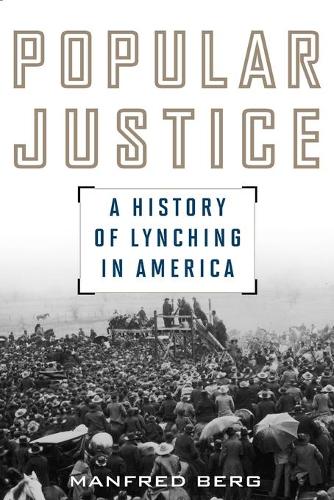
Книга Popular Justice: A History of Lynching in America
Lynching has often been called "America's national crime" that has defined the tradition of extralegal violence in America. Having claimed many thousand victims, "Judge Lynch" holds a firm place in the dark recesses of our national memory. In Popular Justice, Manfred Berg explores the history of lynching from the colonial era to the present. American lynch law, he argues, has rested on three pillars: the frontier experience, racism, and the anti-authoritarian spirit of grassroots democracy. Berg looks beyond the familiar story of mob violence against African American victims, who comprised the majority of lynch targets, to include violence targeting other victim groups, such as Mexicans and the Chinese, as well as many of those cases in which race did not play a role. As he nears the modern era, he focuses on the societal changes that ended lynching as a public spectacle. Berg's narrative concludes with an examination of lynching's legacy in American culture. From the colonial era and the American Revolution up to the twenty-first century, lynching has been a part of our nation's history. Manfred Berg provides us with the first comprehensive overview of "popular justice."
"Berg traces lynching’s U.S. history, starting with the Colonial era and coming to the present, addressing the characteristics of this brutal punishment undertaken by 'ordinary' people." - Library Journal
"Even the ancient Greeks saw the danger that democracy and other forms of popular government could degenerate into mob rule. In this thought-provoking and disturbing history of lynching from colonial times to the present, Berg, a history professor at the University of Heidelberg, draws a clear connection between lynching and a perversion of democratic impulses. Berg views racism as a fundamental component of many lynchings, particularly after the Civil War, when many white southerners rejected the authority of various Reconstructionist state and local governments. African Americans were the most frequent victims, but other racial and ethnic minorities were often targets. Obviously, simple mob blood-lust plays a role, but at a deeper level, Berg asserts that the perpetrators of lynchings often see themselves as antiauthoritarian avengers, representing the popular will and standing in opposition to an 'illegitimate' state power that cannot be trusted to act swiftly or justly. This is a well-written examination of the history and psychology of this particular form of mob violence." - Booklist
"Popular Justice explores lynching from the colonial period to the present, closing with emphasis on the societal changes that contributed to the demise of extralegal violence....Recommended." - CHOICE