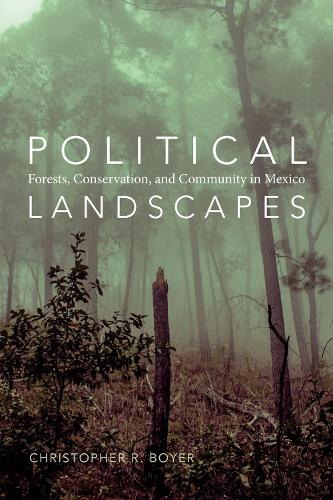
Книга Political Landscapes: Forests, Conservation, and Community in Mexico
Following the 1917 Mexican Revolution inhabitants of the states of Chihuahua and Michoacán received vast tracts of prime timberland as part of Mexico's land redistribution program. Although locals gained possession of the forests, the federal government retained management rights, which created conflict over subsequent decades among rural, often indigenous villages; government; and private timber companies about how best to manage the forests. Christopher R. Boyer examines this history in Political Landscapes, where he argues that the forests in Chihuahua and Michoacán became what he calls "political landscapes"—that is, geographies that become politicized by the interactions between opposing actors—through the effects of backroom deals, nepotism, and political negotiations. Understanding the historical dynamic of community forestry in Mexico is particularly critical for those interested in promoting community involvement in the use and conservation of forestlands around the world. Considering how rural and indigenous people have confronted, accepted, and modified the rationalizing projects of forest management foisted on them by a developmentalist state is crucial before community management is implemented elsewhere.
"Christopher R. Boyer’s superb history of forests, forestry, and conservation in Mexico makes innovative contributions to the historiography of the Mexican Revolution and postrevolutionary state formation, as well as to Mexico’s environmental history." - American Historical Review
"Boyer’s book is a significant accomplishment because it points a practical way forward in ongoing policy debates over the use of Mexico’s temperate forests—which will always represent contested, political landscapes—as well as reinforcing the nation’s overwhelming drive toward modernity over the long arc of the twentieth century." - Hispanic American Historical Review
"This volume offers a much-needed, detailed historiography of Mexican forestry.... [T]he analysis of community forestry, especially, contains offerings that make the read worthwhile." - Agricultural History
"Documenting one hundred years of forest history is not easy, but Boyer has accomplished it in a book that has much to recommend it for classroom use.... [A]n excellent book that includes something not typical in history texts: a dose of humor. If you have never heard of 'pyromaniac campesinos' (p. 97), pick up this book." - The History Teacher
"Political Landscapes is an incredible work of scholarship and an energetic example of environmental history’s potential.... You need not be interested in Mexico or even in forests to appreciate how this book excavates the repeating patterns of environmental history as a more complete rendering of the past." - Environmental History
"[A]n impressive and important contribution to a number of fields. It will be necessary reading for scholars of Latin American environmental history, and deserves an audience among broad-minded policy-makers concerned with contemporary ecological problems. It will also be of great interest to historians of rural transformations and state formation in modern Mexico. The book’s clear prose and able blend of national trends with compelling local detail will benefit students in upper-level undergraduate courses and above." - Journal of Latin American Studies
"Boyer’s book represents a signal achievement by persuasively documenting the ways forests in Mexico were shaped less by market forces, management policies, or population pressures than by the effects of political negotiation among the people and institutions that vied to determine how and for whose benefit they would be used. This book should be required reading for anyone interested in postrevolutionary Mexico and is ideal for use in upper-division undergraduate classes." - The Latin Americanist
"Christopher R. Boyer has written an empirically rich, conceptually sophisticated, and analytically sharp history of Mexico’s forests from the era of Porfirian development to the neoliberal present." - EIAL
"A pioneering history of environmental politics, the timber industry, and community activism in twentieth-century Mexico. . . . Impressive in its scope. Few histories of modern Mexico explore such a broad period." - Labor