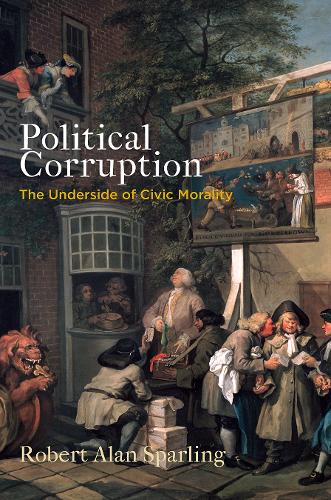
Книга Political Corruption: The Underside of Civic Morality
Political Corruption considers the different ways in which a metaphor of impurity, disease, and dissolution was deployed by political philosophers from the Renaissance to the early twentieth century. It argues that speaking coherently about political corruption in our present moment requires a robust account of the good regime.
The notion of corruption as a problem for politics spans many centuries and political, social, and cultural contexts. But it is incredibly difficult to define what we mean when we describe a regime or actor as corrupt: while corruption suggests a falling away from purity, health, or integrity, it flourishes today in an environment that is often inarticulate about its moral ideals and wary of perfectionist discourse. Providing a historical perspective on the idea, Robert Alan Sparling explores diverse visions of corruption that have been elucidated by thinkers across the modern philosophical tradition.
In a series of chronologically ordered philosophical portraits, Political Corruption considers the different ways in which a metaphor of impurity, disease, and dissolution was deployed by political philosophers from the Renaissance to the early twentieth century. Focusing specifically on the thought of Erasmus, Étienne de La Boétie, Machiavelli, Montesquieu, Bolingbroke, Robespierre, Kant, and Weber, Sparling situates these thinkers in their historical contexts and argues that each of them offers a distinctive vision of corruption that has continuing relevance in contemporary political debates. He contrasts immoderate purists with impure moderates and reveals corruption to be a language of reaction and revolution. The book explores themes such as the nature of civic trust and distrust; the relationship of transparency to accountability; the integrity of leaders and the character of uncorrupted citizens; the division between public and private; the nature of dependency; and the relationship between regime and civic disposition.
Political Corruption examines how philosophers have conceived of public office and its abuse and how they have sought to insulate the public sphere from anticivic inclinations and interests. Sparling argues that speaking coherently about political corruption in our present moment requires a robust account of the good regime and of the character of its citizens and officeholders.
"Political Corruption has much to recommend it. Sparling provide snuanced readings of canonical texts, finding surprising commonalities across varying historical contexts, while not shying away from substantial differences, particularly in how different arrangements of state power may lead to differing conceptions of political dysfunction. And he makes a compelling case for the continued robustness of these several modes of corruption discourse. The book is also written with real humor and brio; it is an all-too-rare pleasure to burst out laughing when reading an academic monograph, much less one on such an otherwise gloomy topic." - H-FRANCE
"In his striking and worthwhile juxtapositions of familiar and lesser-known thinkers, Robert Alan Sparling displays a sophisticated grip on the theories of his subjects and makes an original contribution to our understanding of the idea of political corruption." - Christopher Brooke, University of Cambridge
"Fluid, erudite, impressive in scope, and with moments of wit and humor, Political Corruption illuminates the broad meaning of corruption in modern political thought as well as in everyday political discourse." - Emily C. Nacol, University of Toronto