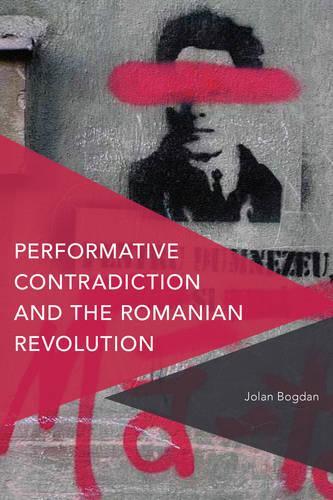
The Romanian Revolution of 1989 ended 42 years of Communist rule. It was the bloodiest revolution in a Warsaw Pact country, culminating in the overthrow and execution of Nicolae Ceaușescu. However, there was no major democratic reform and power remained in the hands of key figures from the old regime. This has led many theorists to question the authenticity of the entire revolution.
Performative Contradiction and the Romanian Revolution focuses-in on the circumstances which led to these accusations. It argues that the notion of an authentic revolution, as a conceptual paradigm, is neither a sufficient, appropriate, nor useful tool for an analysis of the events in Romania. Engaging with the work of theorists including Stieglar, Agamben, Baudrillard, Badiou, Spinoza and Derrida it argues that performative contradiction is a more useful theoretical model for exploring this event. Applying the concept to specific cases within the revolution, the book demonstrates the power of performative contradiction as an analytic tool.
"Within the concluding section of the book, Bogdan demonstrates that performative contradiction, as a conceptual paradigm, proves a “productive and versatile” tool, which can be successfully employed to examine a variety of recent events, ranging from the Arab Spring and the current tensions within the European Union to the ongoing refugee crisis (190). Reading this volume, one becomes more and more aware that performative contradiction is indeed a useful tool, which not only enables new insights into the intricacies of the bloody revolution of 1989 in Romania, but also allows new approaches to worrisome phenomena facing the present day world." - Slavic Review