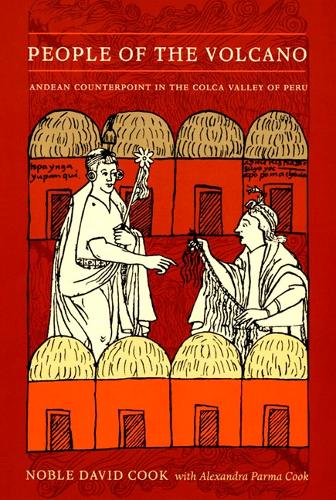
Книга People of the Volcano: Andean Counterpoint in the Colca Valley of Peru
First full-length history of the Colca Valley in southern Peru from pre-Hispanic times to the present
While it now attracts many tourists, the Colca Valley of Peru’s southern Andes was largely isolated from the outside world until the 1970s, when a passable road was built linking the valley—and its colonial churches, terraced hillsides, and deep canyon—to the city of Arequipa and its airport, eight hours away. Noble David Cook and his co-researcher Alexandra Parma Cook have been studying the Colca Valley since 1974, and this detailed ethnohistory reflects their decades-long engagement with the valley, its history, and its people. Drawing on unusually rich surviving documentary evidence, they explore the cultural transformations experienced by the first three generations of Indians and Europeans in the region following the Spanish conquest of the Incas.
Social structures, the domestic export and economies, and spiritual spheres within native Andean communities are key elements of analysis. Also highlighted is the persistence of duality in the Andean world: perceived dichotomies such as those between the coast and the highlands, Europeans and Indo-Peruvians. Even before the conquest, the Cabana and Collagua communities sharing the Colca Valley were divided according to kinship and location. The Incas, and then the Spanish, capitalized on these divisions, incorporating them into their state structure in order to administer the area more effectively, but Colca Valley peoples resisted total assimilation into either. Colca Valley communities have shown a remarkable tenacity in retaining their social, economic, and cultural practices while accommodating various assimilationist efforts over the centuries. Today’s population maintains similarities with their ancestors of more than five hundred years ago—in language, agricultural practices, daily rituals, familial relationships, and practices of reciprocity. They also retain links to ecological phenomena, including the volcanoes from which they believe they emerged and continue to venerate.
"“People of the Volcano provides rich and specific information on the sixteenth- and seventeenth-century Colca Valley that will be enormously useful to specialists in Andean studies. It also provides a fine-grained description of colonial institutions and the Spanish debates over control of indigenous peoples and how to manage extraction of resources from conquered communities. Its usefulness thus extends well beyond Andean studies.”" - Journal of the Royal Anthropological Institute
"“People of the Volcano’s most compelling characteristic is the almost seamless way in which environmental, social, cultural, economic, epidemiological and ecclesiastical historiographical approaches. . . . People of the Volcano condenses effortlessly some three decades of research on the Colca Valley and its people. . . . The authors’ mastery of the sources allows them to bring to life the experience of both the indigenous and the Spanish colonizers. . . .[T]here is no doubt that this is a major piece of historical scholarship. . . .”" - EIAL
"“The definitive work on the Colca Valley under Spanish colonial rule and . . . one of the best in . . . regional ethnohistories of native Andean societies.”" - Hispanic American Historical Review
"“Cook’s book is a masterful synthesis of methodologies from geography, demography, and anthropology. . . . Cook’s analysis of changes in the landscape evinces a familiarity with the geography of the region that, together with his extensive archival research, provides a fruitful approach for a regional study.”" - Journal of Interdisciplinary History
"“The research adventure of many years, following many twists and turns, has led to a fine book. . . .[It] is one of the best and most richly documented regional studies of indigenous peoples and Spaniards in the early colonial Andes to appear in some time. We ought keenly to await volume three in this trilogy.”" - American Historical Review
"“This is an excellent book, which is very well researched and written. It gives anyone studying the Incas or pre-Columbian history a deep insight into their customs, history and administration. It does concentrate on the Colca valley, but through it the authors present an outstanding version of life during the Empire and the colonial period. I would recommend this book not only to historians, but to anthropologists and archaeologists who are studying the Incas as a culture.”" - Bulletin of Latin American Research