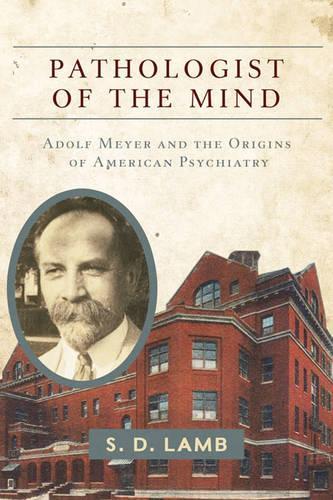
Книга Pathologist of the Mind: Adolf Meyer and the Origins of American Psychiatry
Pathologist of the Mind clearly articulates the techniques and methods of reasoning that set Adolf Meyer's approach apart from those of his contemporaries. His clinical empiricism made for a quintessentially American approach to psychiatry: inclusive and practical, but unrestrained by too many theoretical considerations. Many, perhaps most, psychiatrists know that Meyer is an important figure in American psychiatry, but usually don't quite know why. Dr. Lamb's superb book makes the reasons pellucidly clear. -- Francis Mark Mondimore, M.D., Department of Psychiatry and Behavioral Sciences, Johns Hopkins University School of Medicine Lamb looked in the right place to find the real Adolf Meyer-his detailed case histories of patients. Meyer was a superb brain scientist and neuropathologist, but he was convinced that this alone was an insufficient frame for understanding the problems of psychiatric patients. The dynamic tensions which drove him to formulate his patient-centered 'psychobiological' approach are the same tensions we see and argue about in the field of psychiatry today. -- J Raymond DePaulo, Jr., M.D., Henry Phipps Professor and Director, Department of Psychiatry and Behavioral Sciences, Johns Hopkins University School of Medicine
During the first half of the twentieth century, Adolf Meyer was the most authoritative and influential psychiatrist in the United States. In 1908, when the Johns Hopkins Hospital established the first American university clinic devoted to psychiatry - still a nascent medical specialty at the time - Meyer was selected to oversee the enterprise. The Henry Phipps Psychiatric Clinic opened in 1913, and Meyer served as psychiatrist-in-chief at the hospital until 1941. In Pathologist of the Mind, S. D. Lamb explores how Meyer used his powerful position to establish psychiatry as a clinical science that operated like the other academic disciplines at the country's foremost medical school. In addition to successfully arguing for a scientific and biological approach to mental illness, Meyer held extraordinary sway over state policies regarding the certification of psychiatrists. He also trained hundreds of specialists who ultimately occupied leadership positions and made significant contributions in psychiatry, neurology, experimental psychology, social work, and public health. Although historians have long recognized Meyer's authority, his concepts and methods have never before received a systematic historical analysis. His convoluted theory of "psychobiology," along with his notoriously ineffective attempts to explain it in print, continue to baffle many clinicians. Pathologist of the Mind aims to rediscover Meyerian psychiatry by eavesdropping on Meyer's informal and private conversations with his patients and colleagues. Weaving together private correspondence and uniquely detailed case histories, Lamb examines Meyer's efforts to institute a clinical science of psychiatry in the United States-one that harmonized the expectations of scientific medicine with his concept of the person as a biological organism and mental illness as an adaptive failure. The first historian ever granted access to these exceptional medical records, Lamb offers a compelling new perspective on the integral but misunderstood legacy of Adolf Meyer.