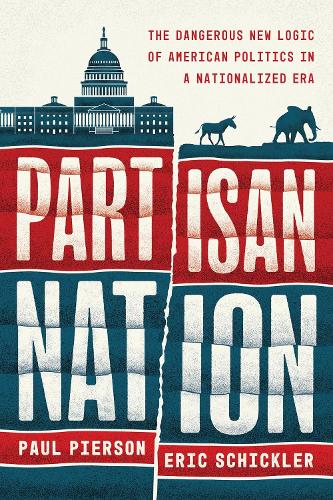
Книга Partisan Nation: The Dangerous New Logic of American Politics in a Nationalized Era
A provocative exploration of how America’s democratic crisis is rooted in a dangerous mismatch between our Constitution and today’s nationalized, partisan politics.
The ground beneath American political institutions has moved, with national politics subsuming and transforming the local. As a result, American democracy is in trouble.
In this paradigm-shifting book, political scientists Paul Pierson and Eric Schickler bring a sharp new perspective to today’s challenges. Attentive to the different coalitions, interests, and incentives that define the Democratic and Republican parties, they show how contemporary polarization emerged in a rapidly nationalizing country and how it differs from polarization in past eras. In earlier periods, three key features of the political landscape—state parties, interest groups, and media—varied locally and reinforced the nation’s stark regional diversity. But this began to change in the 1960s as the two parties assumed clearer ideological identities and the power of the national government expanded, raising the stakes of conflict. Together with technological and economic change, these developments have reconfigured state parties, interest groups, and media in self-reinforcing ways. The result is that today’s polarization is self-perpetuating—and intensifying.
Partisan Nation offers a powerful caution. As a result of this polarization, America’s political system is distinctly and acutely vulnerable to an authoritarian movement emerging in the contemporary Republican Party, which has both the motive and the means to exploit America’s unusual Constitutional design. Combining the precision and acuity characteristic of their earlier work, Pierson and Schickler explain what these developments mean for American governance and democracy.
"Noted political scientists Pierson and Schickler draw on their extensive scholarship to examine various periods of American history during which polarization was particularly virulent....[Partisan Nation] is well researched, and the authors’ analysis of past eras of polarization changes in what they label 'intermediary institutions' such as interest groups and mass media is incisive....An intriguing...examination of the toxic American political landscape." - Kirkus
"Paul Pierson and Eric Schickler’s Partisan Nation is a groundbreaking work about U.S. politics that arrives amidst a tumultuous presidential campaign. Released days before the contentious first—and possibly only—debate between Donald Trump and Kamala Harris, the book seeks to define the issues behind the intractable polarization playing out in the American electorate." - Washington Independent Review of Books
"Is our political system in such a uniquely terrible place? Paul Pierson and Eric Schickler think that it is, and they spell out their reasons in Partisan Nation. . . . [Their] argument is that Madison’s solution no longer works. This is not just because the Internet has made the notion of 'geographic dispersion' obsolete. It’s also because the nature of politics has changed." - The New Yorker
"Ruled by elected leaders for hundreds of years, the U.S. seems like it ought to be the paradigmatic example of a consolidated democracy. So how, after all that time, could the American democratic project be coming apart?. . . .Paul Pierson and Eric Schickler, two leading scholars of American politics, [show that] increasingly extreme partisanship warped American politics in ways that created many of the effects of the autocrat’s playbook, paving the way for Trump long before he tried to run the plays." - New York Times Magazine
"Pierson and Schickler explain why the long-held assumption that competition in the United States’ two-party system will drive both parties to compete for voters in the center no longer holds." - Foreign Affairs