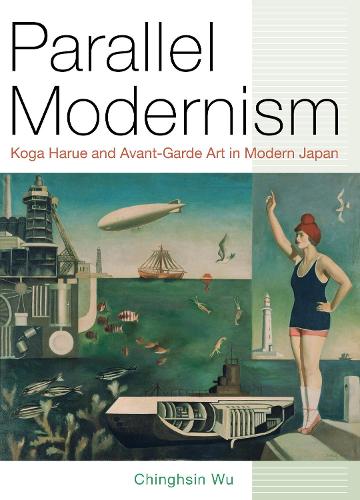
This significant historical study recasts modern art in Japan as a “parallel modernism” that was visually similar to Euroamerican modernism, but developed according to its own internal logic. Using the art and thought of prominent Japanese modern artist Koga Harue (1895–1933) as a lens to understand this process, Chinghsin Wu explores how watercolor, cubism, expressionism, and surrealism emerged and developed in Japan in ways that paralleled similar trends in the west, but also rejected and diverged from them. In this first English-language book on Koga Harue, Wu provides close readings of virtually all of the artist’s major works and provides unprecedented access to the critical writing about modernism in Japan during the 1920s and 1930s through primary source documentation, including translations of period art criticism, artist statements, letters, and journals.
"Contributes significantly to our understanding of twentieth-century Japan and the intertwined trajectories of personal artistic careers, art groups and networks on the one hand and global art trends and local developments on the other. This book will be a useful reference not only for art historians specializing in modern Japanese art, but also a valuable teaching resource for courses on modernisms and modernities, various -isms and their global reverberations, and for teaching in the field of Japanese visual culture." - Sehepunkte
"This book does the important work of global art history but simultaneously reiterates the importance of a deep knowledge of nationally based archives, scholarship, and artworks." - Journal of Japanese Studies