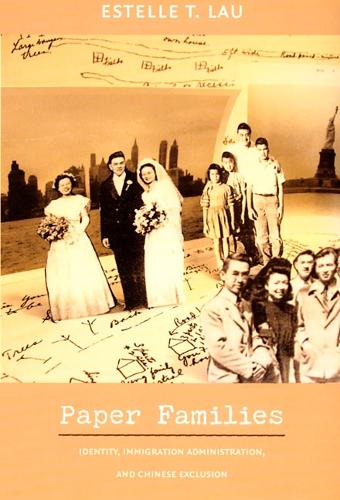
Книга Paper Families: Identity, Immigration Administration, and Chinese Exclusion
Cultural and legal study of the Chinese Exclusion Acts, which restricted Chinese immigration into the U.S., and the efforts of immigrants to circumvent these policies through the creation of fictive families.
The Chinese Exclusion Act of 1882 made the Chinese the first immigrant group officially excluded from the United States. In Paper Families, Estelle T. Lau demonstrates how exclusion affected Chinese American communities and initiated the development of restrictive U.S. immigration policies and practices. Through the enforcement of the Exclusion Act and subsequent legislation, the U.S. immigration service developed new forms of record keeping and identification practices. Meanwhile, Chinese Americans took advantage of the system’s loophole: children of U.S. citizens were granted automatic eligibility for immigration. The result was an elaborate system of “paper families,” in which U.S. citizens of Chinese descent claimed fictive, or “paper,” children who could then use their kinship status as a basis for entry into the United States. This subterfuge necessitated the creation of “crib sheets” outlining genealogies and providing village maps and other information that could be used during immigration processing.
Drawing on these documents as well as immigration case files, legislative materials, and transcripts of interviews and court proceedings, Lau reveals immigration as an interactive process. Chinese immigrants and their U.S. families were subject to regulation and surveillance, but they also manipulated and thwarted those regulations, forcing the U.S. government to adapt its practices and policies. Lau points out that the Exclusion Acts and the pseudo-familial structures that emerged in response have had lasting effects on Chinese American identity. She concludes with a look at exclusion’s legacy, including the Confession Program of the 1960s that coerced people into divulging the names of paper family members and efforts made by Chinese American communities to recover their lost family histories.
"“A careful reading of Lau’s book can shed light on the futility of tying to exclude a specific group of people from emigrating to the U. S. . . . Given the acrimonious positions on both sides of the current immigration ‘debate,’ Paper Families is a book that adds to the literature on both Chinese immigration to the U. S. and U. S. immigration policy in general.”" - Contemporary Sociology
"“Based on painstaking sorting and analysis of archival immigration files and supplementary data, including internal memoranda, congressional records, and historical sources, Lau provides a credible account of the struggle for existence and identity that adds to a much deeper understanding of Chinese American history. . . . Paper Families constitutes an insightful new study of Chinese exclusion and makes an original contribution to research on Chinese immigration and Chinese American history.”" - American Journal of Sociology
"“Lau’s lucid description of the reciprocal relations between the power of the state and the power of civil society is an important contribution to the scholarly literature in the sociolegal field. . . . This is a book worth reading, and reading carefully. It is thoughtful, well written, and it would be a great resource for anyone interested in the Chinese American experience or the development of the immigration and naturalization services.”" - Ethnic and Racial Studies