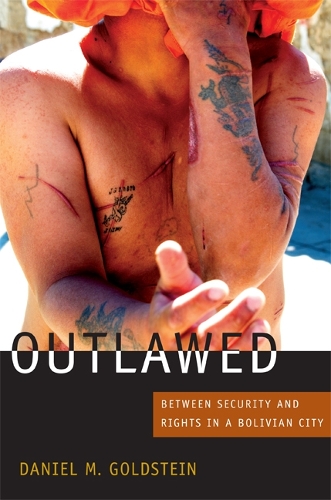
Книга Outlawed: Between Security and Rights in a Bolivian City
Illuminates the complex interconnections between differing definitions of security and human rights
In Outlawed, Daniel M. Goldstein reveals how indigenous residents of marginal neighborhoods in Cochabamba, Bolivia, struggle to balance security with rights. Feeling abandoned to the crime and violence that grip their communities, they sometimes turn to vigilante practices, including lynching, to apprehend and punish suspected criminals. Goldstein describes those in this precarious position as "outlawed": not protected from crime by the law but forced to comply with legal measures in other areas of their lives, their solutions to protection criminalized while their needs for security are ignored. He chronicles the complications of the government's attempts to provide greater rights to indigenous peoples, including a new constitution that recognizes "community justice." He also examines how state definitions of indigeneity ignore the existence of marginal neighborhoods, continuing long-standing exclusionary practices. The insecurity felt by the impoverished residents of Cochabamba—and, more broadly, by the urban poor throughout Bolivia and Latin America—remains. Outlawed illuminates the complex interconnections between differing definitions of security and human rights at the local, national, and global levels.
"“Daniel Goldstein has written an elaborate and rich ethnography of the ‘present absence’ of the Bolivian state in a marginal barrio in the city of Cochabamba. . . . In many ways, Goldstein’s book is a testimony to ethnography at its best: it elucidates large critical issues by way of meticulous attention to local contexts and dynamics.”" - Journal of Latin American Studies
"“Outlawed presents a theoretical tour de force that draws the reader into complicating and questioning long-standing tropes of urban/rural, indigenous/civilized, and neoliberal/ communal that clearly continue to affect governmentality and everyday experiences of citizenship in contemporary Bolivia. As such, it is a must-read for scholars of the Andes, of neoliberal citizenship in all its manifestations, and—more importantly—for anyone concerned with the renewed scrutiny of security in the global south.”" - Journal of Anthropological Research
"“Although Outlawed is an ethnography based on fieldwork with participant observation, traditional ethnographic description occupies only about forty percent of the text. The remainder is roughly forty percent theory and engagement with other literature, and twenty percent discussion of the personal role of the anthropologist. Each of the three elements contributes something to make Outlawed a valuable… work.”" - The Latin Americanist
"Outlawed will undoubtedly inspire important debates on the place of 'engaged anthropology' in our discipline, while inadvertently showing that our scholarly production is often not as collaborative as our activism." - American Ethnologist
"“Through compelling, sensitive, and lyrically written ethnographic analyses, Goldstein takes up a number of key problems for contemporary anthropology. . . . After Outlawed, it is no longer possible to view the role of human rights as a dominant mode of contemporary world-making in the same way.”" - Journal of the Royal Anthropological Institute