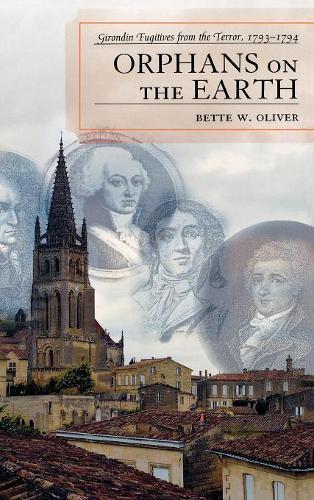
Книга Orphans on the Earth: Girondin Fugitives from the Terror, 1793-94
Just as it was not foreordained that the Terror of 1793–1794 should follow the early idealistic years of the French Revolution, neither could it have been imagined that some of those elected deputies who had helped to establish the new republic would become fugitives from their own government. Yet, in May to June 1793, twenty-nine deputies of the moderate Girondin faction were expelled from the National Convention by the radical Jacobin leadership and placed under house arrest. This action followed months of irreconcilable quarrels between the Girondin and Jacobin factions. Some of the proscribed deputies chose to remain in Paris and were subsequently executed in October 1793. Others escaped, fleeing first to Caen in Normandy, where they hoped to ignite a federalist revolt against the government in Paris. When their efforts failed, a small group of the former deputies fled to nearby Brittany and then down the western coast to the Bordeaux area, where they found refuge near St. Emilion. Hiding for several months in the home and attached stone quarry of the deputy Guadet's relatives, four of these fugitives wrote their memoirs before their presence was discovered by one of Robespierre's agents. The memoirs of François Buzot, Jerome Pétion, Charles Barbaroux, and Jean-Baptiste Louvet, in addition to correspondence between them and Jean and Manon Roland, provide the basis for this book. This is the first book to examine the lives of the fugitives during the period of the Terror (1793–94), after which only Louvet remained alive.
"The phrase "orphans of the earth" was coined by Francois Buzot, one of twenty-nine Girondin deputies expelled from the National Convention in the summer of 1793 following the successful Jacobin coup and placed under house arrest. Those who chose to remain in the capital were put on trial and would die on the guillotine….Oliver tells it well, movingly at times, and does nothing to hide her sympathy for the fugitives and for those who, like Marie-Therese Bouquey in Saint-Emilion, got caught up in their escape and paid a terrible price for helping them. Petite histoire is may be, a story made for the romantic spirit of the age. But it is not without interest, and it provides a fitting postscript to the political careers of some of the most prominent leaders of the Gironde." - American Historical Review
"Oliver's prose is highly readable, and her work will have great appeal to the casual reader and nonspecialist scholar….Oliver's work is a welcome contribution to an overlooked aspect of the Terror." - Eighteenth-Century Studies