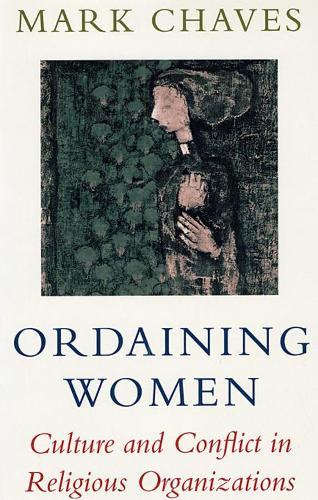
Книга Ordaining Women: Culture and Conflict in Religious Organizations
Demonstrates the creativity, the resourcefulness, the tenacity of a scholar determined to wrestle with a difficult subject. -- Andrew M. Greeley, author of Religious Change in America An extensive bibliography and statistical tables make this historical and comparative analysis of women's ordination in the United States an invaluable background resource, since roughly 30% of the students in today's theological schools are women. Much of the contemporary literature generated around the ordination of women focuses on the concrete experiences of individual women. By contrast, Chaves' work concentrates on the formal policies of the one hundred denominations concerned and the tentative or permanent resolutions that various churches have achieved. Chaves has analyzed sociologically and ecclesially the fact that church policies regarding female clergy frequently fail to correspond to the real world of female ministry. -- Donald Dietrich, Boston College
Why does a denomination prohibiting women clergy support parishes run by women? Why does a denomination opt to ordain women when there are few women seeking to join that clergy? And why have some denominations ordained women so much earlier than others? In a revealing examination of the complex relationship among religion, social forces, and organizational structure, Ordaining Women draws examples and data from over 100 Christian denominations to explore the meaning of institutional rules about women's ordination.
Combining historical and sociological perspectives, Mark Chaves deftly shows that formal institutional rules about ordination often diverge from the actual roles of women and are best understood as symbolic gestures in favor of--or in opposition to--gender equality. Ordaining Women concludes that external pressures from the women's movement and ecumenical pressure expressed through interdenominational organizations such as the National Council of Churches influence ordination practices. At the same time, internal factors such as having a source of religious authority that is considered superior to modern principles of equal rights also explain why some denominations ordain women much earlier than others.
Surprisingly, "the Bible forbids it" does not account for policies even among fundamentalists and other biblical inerrantists. Chaves' historical and comparative approach offers a revealing analysis of how the internal denominational debates have changed over time, becoming more frequent, more politicized, and more contentious. The skillful delineation of forces affecting debates and policies about women's ordination makes this book an important contribution to our understanding of religious organizations and of gender equality.
"Chaves provides a carefully researched and documented study of the 19th and 20th-century ordination policies and practices in the United States, including the Roman Catholic Church...Highly recommended for all libraries; essential for seminary libraries." - Library Journal
"Chaves examines the forces that have influenced debates over women's ordination...The research and the author's conclusions are vital and valuable." - National Catholic Reporter
"[Ordaining Women] challenges both the proponents and the opponents of the ordination of women. Its findings, presented with admirable clarity, should provide both constituencies with much food for thought." - Church Times
"Although based on a large-scale quantitative study, Chaves's book makes illuminating use of official documents as well...A balanced, instructive account." - Christian Century
"[Ordaining Women] is the culmination of several years' work, and it is clearly worth the wait...This book makes important contributions to the literature dealing with women's ordination. No one who wants to understand the roles of women in American churches can afford to ignore this important work." - Journal for the Scientific Study of Religion
"This work is a valuable addition to the literature analyzing the struggle for women's ordination through the lens of organizational theory...Looking at the question from the perspective of sociology of organizations sheds light on a situation not completely explainable theologically...[Chaves's] well-documented and persuasive study makes for interesting and provocative reading." - Theological Studies
"An extensive bibliography and statistical tables make this historical and comparative analysis of women's ordination in the USA an invaluable background resource Women's ordination is about something more than women in leadership. Chaves has deftly analyzed this "more." His work is a good example of sociology applied to religious practice and even demonstrates how theology can undergo permutations." - The European Legacy