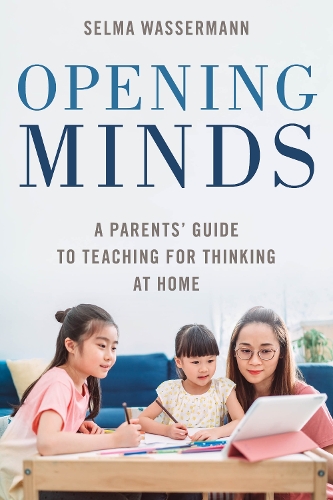
Книга Opening Minds: A Parents' Guide to Teaching for Thinking at Home
When schools, libraries, daycares, and playgrounds closed during the pandemic, children were forced to spend a lot of time at home. These closures left parents responsible for providing educational opportunities for their children to ensure they did not fall behind academically. Today, even with schools and other centers of learning reopened, it is clear that online, in-home learning is here to stay.
Opening Minds is a wonderful resource full of materials for parents of elementary and middle school children who want to expand their learning at home. Though it is not intended to replace or be a substitute for the standard curriculum of the grades, it provides parents with a variety of tools to promote and engage children’s thinking across various curriculum areas – critical thinking that can serve children at any grade level and give them a leg up to deal with whatever they will face.
"
Award-winning professor and author Wassermann has spent her career educating teachers. In this book, she shares her wealth of knowledge with parents and caregivers, explaining the importance of children developing higher-level cognitive thinking skills. She understands that parents are their children’s best teachers, and writes, “As parents would contribute to improving children’s reading abilities, so they might consider aiding and abetting what teachers do in classrooms to further children’s intelligent habits of mind.” Opening Minds walks caregivers through thirteen “thinking operations” and provides them with engaging activities for pre- and emerging readers as well as middle-grade students. With Wasserman’s accessible ideas, children can practice higher-level cognitive skills from observing, comparing, classifying, and imagining to hypothesizing, summarizing, interpreting, and problem-solving after simple preparation and guidance from an adult at home. This incredibly useful guide for parents provides essential critical thinking practice to help kids successfully navigate today’s everchanging and challenging world.
" - Booklist"
During an unprecedented time, as many more children experience home-based schooling, they and their parents face new educational challenges on top of emotional turmoil, and parents have taken on additional roles. Learning to think intelligently necessitates both experience and further practice. Children who function well on low-level cognition are not always able to succeed at higher-level functioning tasks, and in order to grow they must have opportunities for thinking at all levels. The parent’s role is to choose activities that match the development level and interests of their child. Divided into chapters by level, the book is full of ideas for incorporating observing, comparing, classifying, imagining, hypothesizing, and other advanced thinking skills. Sample activities for elementary students include finding similarities and differences between a sea turtle and a fish; creating a hypothesis about how spiders create webs and then testing it; and making a visual model of the circulatory system. This work will prove valuable for teachers and parents with its hands-on activities.
" - Library Journal"
Parents can “become teacher-surrogates in implementing the very essential work of continuing to open children’s minds,” writes education professor Wassermann in this comprehensive guide to filling the gaps created by school shutdowns during the pandemic. She argues that “our long-term survival” may depend on children’s ability to analyze, problem-solve, and innovate. In explaining how to engage and develop a child’s critical thinking skills, she breaks down a dozen “thinking operations.” Observing, for example, helps children make sense of the world, while comparing is a skill that leads to making better judgments. The heart of Wassermann’s guidance comes in the form of hundreds of activities, grouped by reading ability: there’s a list of questions to ask both pre-readers and middle grade students to help them form hypotheses, as well as lists of age-appropriate topics to compare, such as a bear and a pig for the younger group, and TV and radio for the older. [T]his is an informative deep-dive into what makes children critical thinkers.
" - Publishers Weekly