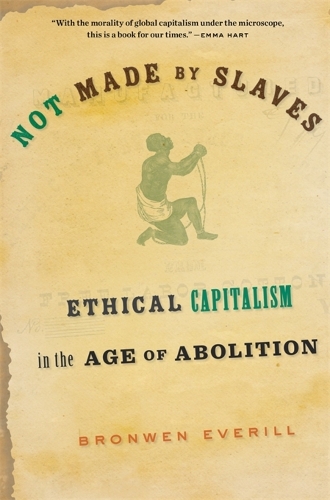
Книга Not Made by Slaves: Ethical Capitalism in the Age of Abolition
“Impressive…[Readers] will be rewarded with greater understanding of historical developments that changed the relationship between consumers and producers in a global economy in ways that reverberate to this day.”
—Wall Street Journal
“Everill repositions West Africa as central to the broader Atlantic story of 18th and 19th century economic morality, its relationship with commercial ethics, and the expansion of capitalism.”
—Financial Times
“Offers a penetrating new perspective on abolition in the British Empire by spotlighting a particular cast of characters: the commercial abolitionists in West Africa who fashioned a consumer-focused, business-friendly antislavery ethics. These figures sought to prove the moral and economic superiority of non-slave labor while profiting from the transition away from slavery…Impressive.”
—Jacobin
“East India Sugar Not Made By Slaves.” With these words inscribed on a sugar bowl, nineteenth-century consumers were reminded of their power to change the global economy. Determined to strike at the heart of the slave trade, abolitionist businesses throughout the Atlantic used new ideas of supply and demand, consumer credit, and branding to make the case for ethical capitalism.
Consumers became the moral compass of capitalism as companies in West Africa, including Macaulay & Babington and Brown & Ives, developed clever new tactics to make “legitimate” commerce pay. Yet ethical trade was not without its problems. The search for goods “not made by slaves” unwittingly expanded the reach of colonial enterprises in the relentless pursuit of cheap labor. Not Made by Slaves captures the moral dilemmas roiling the early years of global consumer society and is a stark reminder of the unintended consequences of relying on consumer self-interest to transform global capitalism.
"Impressive scholarship…[Readers] will be rewarded with greater understanding of historical developments that changed the relationship between consumers and producers in a global economy in ways that reverberate to this day." - Wall Street Journal
"Everill repositions West Africa as central to the broader Atlantic story of 18th and 19th century economic morality, its relationship with commercial ethics, and the expansion of capitalism." - Financial Times
"An exceptional interpretation of how the Atlantic world envisioned social responsibility and how some people faced questions about ethical capitalism that still vex us today." - Origins
"Offers a penetrating new perspective on abolition in the British Empire by spotlighting a particular cast of characters: the commercial abolitionists in West Africa who fashioned a consumer-focused, business-friendly antislavery ethics. These figures sought to prove the moral and economic superiority of non-slave labor while profiting from the transition away from slavery…Impressive." - Jacobin
"[A] brisk jaunt through decades of history…This is a book that intervenes masterfully in various fields…[and] can be read profitably alongside the burgeoning scholarship that seeks to understand the rise and evolution of capitalism itself." - S-USIH: Society for U.S. Intellectual History
"[An] incisive history of political economy." - London Review of Books
"Intriguing…Armed with fresh insights from the new history of slavery and capitalism, Everill argues that scholars must launch a renewed investigation into the origins of abolitionism in the Atlantic World. If—as the new history contends—slavery was itself capitalist, then we can no longer assume that the triumph of capitalism made abolitionism inevitable…Not Made by Slaves successfully knits together U.S. and West African history in novel ways that will make it especially useful and exciting for early Americanists looking to expand their transnational reach." - Business History Review
"Everill’s challenging study ultimately reveals that ‘ethical capitalism’ was (and remains) at heart an oxymoron." - Indiana Magazine of History