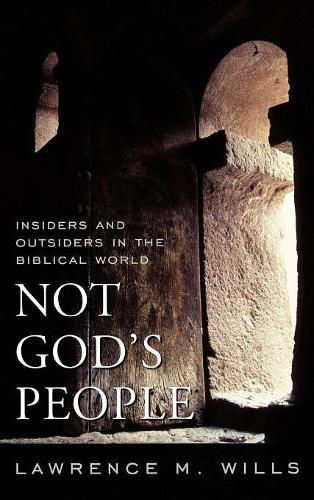
Книга Not God's People: Insiders and Outsiders in the Biblical World
In the Bible, there is a drama of defining who are truly God's people—and who are not. Using an array of biblical texts from both the Hebrew Bible and the New Testament, Not God's People explores how ancient Jews and Christians created their own identity in relation to others. The book analyzes how biblical texts define 'us' and 'them,' how these texts differ in the way they define group identity, and how this process continues to be re-created by Jews and Christians today. Not God's People asks questions such as: How is the outsider defined? Is the ideal insider defined as the opposite of the outsider? It follows up with related questions such as: How were these definitions of 'we' and 'other' in the ancient communities used by later Jews and Christians? Are the processes of community and enemy formation found in the Bible exhibited in most other cultures as well? Not God's People ultimately shows that though the Bible's definitions of the insider and outsider changes dramatically over time, the process are enduring, and eternally true.
"In this clearly written, well-organized, and articulately argued monograph, Wills offers a theoretical introductory chapter, a wide-ranging reflection on the Hebrew Bible's construction of the Other, some brief concluding remarks, and studies of the following biblical texts: Ezra-Nehemiah, 1 and 2 Maccabees, Matthew, John, the Pauline corpus, and Acts. W. combines acute textual skills with a set of nine social-scientific theorems to elucidate hwo groups, both ancient and modern, construct the Other and in turn conceive of their own identity in relation to the Other. . . . There is no doubt that W. has produced an important book on a timely topic." - Catholic Biblical Quarterly
"This very interesting book traces the development of Israel's national identity. . . . Methods from historical criticism, the social sciences, and culture studies are employed in this carefully researched study. The book throws necessary light on ways that those who adhere to one religious tradition view those who adhere to another." - The Bible Today
"Not God's People shows that in different times and different cultural settings the essence of the Other is always different, but the construction of the Other always uses the same patterns . . . A worthy contribution to the series Religion in the Modern World . . . A very accessible book . . . Not God's People deals with texts that often raise more questions than answers, such as the order to completely extinguish other people or the condemnation of the Jews in the New Testament. Wills shows in a convincing way that those texts are often more complex and nuanced than we assume." - Review of Biblical Literature
"This important book can help us to understand the complex role that the construction of the Other can play in identity formation.... This well-written and engaging book will be of interest to scholars and general readers alike. It is not only an excellent study in biblical exegesis and thought, but also has implications for the ongoing relationship between identity and the Other in our own times." - Interpretation
"Wills writes from a theoretically informed position that specialists will find provocative and engaging, yet his clear prose ensures that his book will also be a useful resource for advanced undergraduates." - Religious Studies Review
"In investigating various biblical texts, Wills, professor of biblical studies at Episcopal Divin- ity School in Cambridge, MA, asks the following questions: How is the outsider defined? Is the insider defined as the opposite of the outsider? How does this define God and community in each case? and Does this also define some people within the community who are likened to the outside enemy? After a nineteen-page introduction, he treats the following topics: the beginning of difference and the origin of others in the Hebrew Bible; the redefinition of “we” and “other” in Ezra-Nehemiah; Judaism and Hellenism in 1 and 2 Maccabees; “scribes and Pharisees, hypo- crites!” in Matthew’s Gospel; the Jews in John’s Gospel; Jew and Gentile as other in Paul; and the other in Acts. Wills concludes that constructing the “other” is a fundamental part of what it means to be human; and that the problem comes when humans refuse to grant that their views of the other are constructions, and that these constructions form the basis of the ordering of society." - New Testament Abstracts