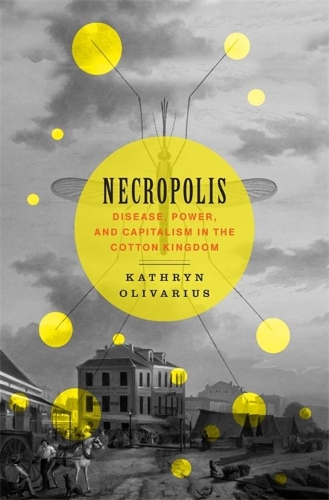
Книга Necropolis: Disease, Power, and Capitalism in the Cotton Kingdom
Disease is thought to be a great leveler of humanity, but in antebellum New Orleans acquiring immunity from the scourge of yellow fever magnified the brutal inequities of slave-powered capitalism.
Antebellum New Orleans sat at the heart of America’s slave and cotton kingdoms. It was also where yellow fever epidemics killed as many as 150,000 people during the nineteenth century. With little understanding of mosquito-borne viruses—and meager public health infrastructure—a person’s only protection against the scourge was to “get acclimated” by surviving the disease. About half of those who contracted yellow fever died.
Repeated epidemics bolstered New Orleans’s strict racial hierarchy by introducing another hierarchy, what Kathryn Olivarius terms “immunocapital.” As this highly original analysis shows, white survivors could leverage their immunity as evidence that they had paid their biological dues and could then pursue economic and political advancement. For enslaved Blacks, the story was different. Immunity protected them from yellow fever, but as embodied capital, they saw the social and monetary value of their acclimation accrue to their white owners. Whereas immunity conferred opportunity and privilege on whites, it relegated enslaved people to the most grueling labor.
The question of good health—who has it, who doesn’t, and why—is always in part political. Necropolis shows how powerful nineteenth-century white Orleanians—all allegedly immune—pushed this politics to the extreme. They constructed a society that capitalized mortal risk and equated perceived immunity with creditworthiness and reliability. Instead of trying to curb yellow fever through sanitation or quarantines, immune white Orleanians took advantage of the chaos disease caused. Immunological discrimination therefore became one more form of bias in a society premised on inequality, one more channel by which capital disciplined and divided the population.
"This book is prescient for the questions it provokes about our experiences of COVID-19…Necropolis shows how elite white people exploited disease in this uniquely unhealthy space for their own personal gain…Olivarius’s new perspectives on yellow fever, immunocapitalism, and the politics of acclimation are a powerful addition to this important body of scholarship that will influence a generation of scholars to come on the intersections of racism, slavery, and public health." - The Lancet
"More than two years into the Covid-19 pandemic, the social, economic and political implications of public health crises are more apparent than ever—as is the fact that people of color and poorer communities often bear the brunt of these contagions’ consequences. [This] new analysis of yellow fever in antebellum New Orleans highlights striking parallels with the ongoing pandemic." - Smithsonian
"Olivarius’s account is rich in thick descriptions of this fevered environment. She adeptly resurrects voices not just from elite men but from women, the impoverished, and even from former slaves…An excellent reconsideration of the impact of yellow fever on a major southern trading port in the antebellum era." - Civil War Book Review
"Necropolis makes a compelling argument for the near-determinative nature of disease in antebellum New Orleans…It is also hard to imagine [a book] more thought-provoking or more appropriate as a mirror to our current moment. Thus, Necropolis will stimulate all readers—as much the general public as students of medical history, American slavery, capitalism, or the South writ large." - H-Net Reviews
"Necropolis offers revelatory insights into how capitalism controls responses to disease, and how disease exacerbates inequalities, arguments that feel particularly prescient in the midst of an ongoing coronavirus pandemic…An engrossing and timely work of scholarship." - Journal of Southern History
"Olivarius puts a rich trove of primary sources to good use, lending the volume authenticity in its arguments and engaging readability while demonstrating the lengths to which New Orleans residents went to preserve the cyclical epidemic status quo, which preserved Creole dominance and limited the success of American and European immigrants." - Choice
"Captivating…Olivarius illuminates the complex workings of ‘immunocapitalism’ and paints a vivid picture of antebellum New Orleans. This is a timely and thought-provoking look at how disease outbreaks have exacerbated inequality in America." - Publishers Weekly