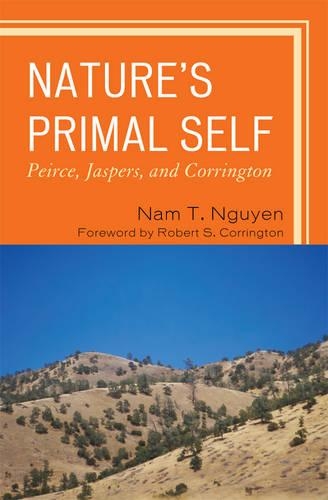
Книга Nature's Primal Self: Peirce, Jaspers, and Corrington
Nature’s Primal Self examines Corrington’s thought, called “ecstatic naturalism,” in juxtaposition to both C. S. Peirce’s pragmatic and semiotic concept of the self and Karl Jaspers’ existential elucidation of Existenz. Peirce’s and Jaspers’ anthropocentrism is thus corrected by Corrington’s ecstatic naturalism. Ecstatic naturalism, as a new movement, is both a semiotic theoretical method and a metaphysics that probes deeply into the ontological divide between nature naturing and nature natured. Author Nam T. Nguyen attempts to achieve three goals: first, to present and elucidate the underlying philosophical concepts of Charles Peirce, Karl Jaspers, and Robert Corrington; second, to critique the anthropocentric self of Peirce’s semiotic pragmatism and of Jaspers’ existential anthropology (periechontology) from the standpoint of ecstatic naturalism; and third, to introduce the concept of nature’s primal self, radically grounded in the perspective of ecstatic naturalism, as a judicious, more encompassing, and richer framework compared to Peirce’s semiotic construction of the self and Jaspers’ existential concept of Existenz.
"As would be expected, Nguyen’s study brings a plethora of interesting philosophical questions to the foreground with respect to these three extraordinary thinkers, making it difficult to know where to start in reviewing the book’s most noteworthy ideas. I take this to be the persistent value in Nguyen’s text, not so much that it reminds us to restrain our temptation to privilege and eulogize the human self (writing it “large on the canvas of nature”), but that it reminds us, in a true Tillichian vein, of our need for ecstatic healing and wholeness. In this respect, Nguyen’s Nature’s Primal Self serves as one of the most helpful interpretations of Corrington’s corpus to date, helping us through the maze of Corrington’s dense but exquisite theoretical framework while keeping us focused on the expectation that drives Corrington’s theorizing, the expectation for nature’s primal self of spiritual transfiguration and ecstasy." - American Journal of Theology and Philosophy