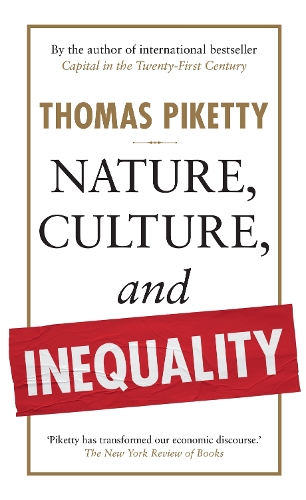
Книга Nature, Culture, and Inequality
A Guardian book to look out for in 2024
An insightful exploration of the nature of inequality by the internationally bestselling author of Capital in the Twenty-First Century.
In his newest work, Thomas Piketty explores how social inequality manifests itself very differently depending on the society and epoch in which it arises. History and culture play a central role, inequality being strongly linked to various socio-economic, political, civilisational, and religious developments. So it is culture in the broadest sense that makes it possible to explain the diversity, extent, and structure of the social inequality that we observe every day.
Piketty briefly and concisely presents a lively synthesis of his work, taking up such diverse topics as education, inheritance, taxes, and the climate crisis, and provides exciting food for thought for a highly topical debate: Does natural inequality exist?
"
Praise for A Brief History of Equality:
‘A sustained argument for why we should be optimistic about human progress … [Piketty] has laid out a plan that is smart, thoughtful, and motivated by admirable political convictions.’
" - The Washington Post"
Praise for A Brief History of Equality:
‘[Piketty] argues that we’re on a trajectory of greater, not less, equality and lays out his prescriptions for remedying our current corrosive wealth disparities.’
" - The New York Times Magazine"
Praise for Capital and Ideology:
‘The book is packed with fascinating detail and vast quantities of skilfully assembled data; it is written (and translated, by Arthur Goldhammer) in an accessible, conversational tone. But Piketty’s vital contribution is somewhat obscured by the book’s title. He is not in the business of uncovering the ideological dynamics that make the interests of the powerful appear to coincide with everyone’s general interest — what Boutmy called “political hegemony” — or in explaining the way they have historically operated. Instead, he gives us a systematic examination of inequality across time and place, and of the ideas the powerful have used to justify it.’
" - London Review of Books"
Praise for Capital and Ideology:
‘Spenglerian in scope, Piketty’s critique reaches far back in history and across the globe … It’s an admirable corrective to the usual Eurocentrism of Western economists … Piketty has modified his thinking since his previous opus. Rather than imply that rising inequality is a problem inherent in capitalism, he now suggests that the levels of inequality we get are the ones we countenance — that they’re entirely a matter of political and ideological choices.’
" - The New Yorker