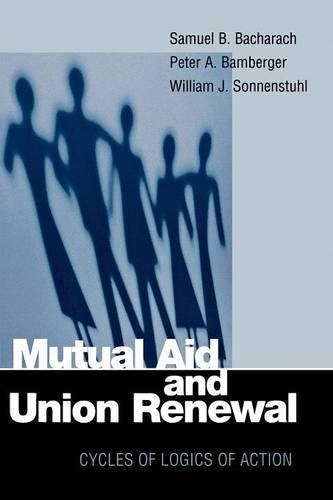
Книга Mutual Aid and Union Renewal: Cycles of Logics of Action
The ongoing decline in union membership is generally attributed to an increasingly hostile economic, legal, and managerial environment. Samuel B. Bacharach, Peter A. Bamberger, and William J. Sonnenstuhl argue that the decline may have more to do with a crisis of union legitimacy and member commitment. They further suggest that both problems could be addressed if the unions return to their nineteenth-century, mutual aid-based roots.The authors contend that the labor movement is characterized by two models of union-member relations: the mutual aid logic and the servicing logic. The first predominated in the early days and encouraged a sense of community among members who worked to support one another. In the twentieth century, it was largely replaced by the servicing model, which asks little of members, who remain loyal only if their leaders deliver increasing wages and benefits.Regaining legitimacy and strengthening member commitment can only happen, the authors claim, if mutual aid logic is allowed to return. They examine three unions in the transportation industry to judge the effectiveness of new programs created after the old model.
The ongoing decline in union membership is generally attributed to an increasingly hostile economic, legal, and managerial environment. Samuel B. Bacharach, Peter A. Bamberger, and William J. Sonnenstuhl argue that the decline may have more to do with a crisis of union legitimacy and member commitment. They further suggest that both problems could be addressed if the unions return to their nineteenth-century, mutual aid-based roots.
The authors contend that the labor movement is characterized by two models of union-member relations: the mutual aid logic and the servicing logic. The first predominated in the early days and encouraged a sense of community among members who worked to support one another. In the twentieth century, it was largely replaced by the servicing model, which asks little of members, who remain loyal only if their leaders deliver increasing wages and benefits.
Regaining legitimacy and strengthening member commitment can only happen, the authors claim, if mutual aid logic is allowed to return. They examine three unions in the transportation industry to judge the effectiveness of new programs created after the old model.
"
In a set of scenarios that offer a sharp contrast to the vision of the collapse of community, the authors describe in splendid detail the emergence and revitalization of the logic of mutual aid in the labor movement. In so doing, they also challenge the dominant perception of the slow and painful demise of the American labor movement.
" - Administrative Science Quarterly"
Mutual Aid and Union Renewal examines the well-known decline of unions in the United States in the past few decades, and argues that unions could renew themselves and once again become a major force. The argument is a fascinating one, and it should draw a great deal of interest and debate.
" - Industrial and Labor Relations Review"
The authors argue that the ongoing decline in union membership may have more to do with a crisis of union legitimacy and member commitment than a hostile economic, legal, and management environment. They suggest problems could be addressed if unions return to their 19th-century, mutual aid-based roots.
" - IRRA Newsletter