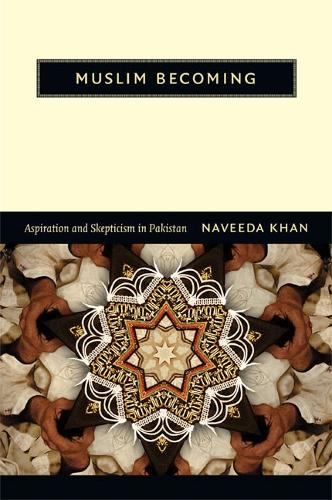
Книга Muslim Becoming: Aspiration and Skepticism in Pakistan
This thoughtful ethnography of Islam in Pakistan moves from the smallest scale - a single worshiper striving to be a better Muslim who is seeking guidance at a neighborhood mosque - to the largest, examining the thought of poet and philosopher Muhammad Iqbal, considered to be the spiritual visionary of the country. While some have thought that Pakistan failed to become a true Muslim state, or that the state's relation to Islam is insincere and political, Khan argues that the basis of Pakistan's Islam is in argument and aspiration, the possibility of becoming rather than tied to a particular outcome. She traces these signs of aspiration and striving in readings of texts and everyday life.
In Muslim Becoming, Naveeda Khan challenges the claim that Pakistan's relation to Islam is fragmented and problematic. Offering a radically different interpretation, Khan contends that Pakistan inherited an aspirational, always-becoming Islam, one with an open future and a tendency toward experimentation. For the individual, this aspirational tendency manifests in a continual striving to be a better Muslim. It is grounded in the thought of Muhammad Iqbal (1877–1938), the poet, philosopher, and politician considered the spiritual founder of Pakistan. Khan finds that Iqbal provided the philosophical basis for recasting Islam as an open religion with possible futures as yet unrealized, which he did in part through his engagement with the French philosopher Henri Bergson. Drawing on ethnographic research in the neighborhoods and mosques of Lahore and on readings of theological polemics, legal history, and Urdu literature, Khan points to striving throughout Pakistani society: in prayers and theological debates and in the building of mosques, readings of the Qur'an, and the undertaking of religious pilgrimages. At the same time, she emphasizes the streak of skepticism toward the practices of others that accompanies aspiration. She asks us to consider what is involved in affirming aspiration while acknowledging its capacity for violence.
"“Read it for its nuances, subtleties and engaging tales of qabza, jinns and mullahs.”" - Asian Affairs
"“Muslim Becoming succeeds largely because it goes against prevailing wisdom, obliging the reader to adopt a different perspective regarding present-day Pakistan by insisting that Pakistan is not a finished product. . . .Readers interested in a radical departure from the typical fare served up
by Washington think-tanks and talking heads will find much of interest in Naveeda Khan’s excellent book.”" - Pakistaniaat
"“Readers of Khan's book will hopefully never see Islam, or Pakistan, the same way again, and I am sure that the same analysis could, should, and will be applied to every other religion, tradition, and culture that binds our future to our past.”" - Anthropology Review Database
"“Thoroughly original and consistently provocative, Muslim Becoming is a tour de force. Through a multilayered ethnography – coupled with textured readings of myriad texts – Naveeda Khan reveals the complexities and contradictions of life in contemporary Pakistan.” " - Anthropos
"“[A]n original and substantive contribution to scholarship on contemporary Islam, and, more generally, to cultural anthropology.”" - International Journal of Middle East Studies
"“Muslim Becoming is an original and important book that argues that the state and citizens in Pakistan have inherited an aspirational understanding of Islam that tends towards experimentation and striving.”" - Economic and Political Weekly