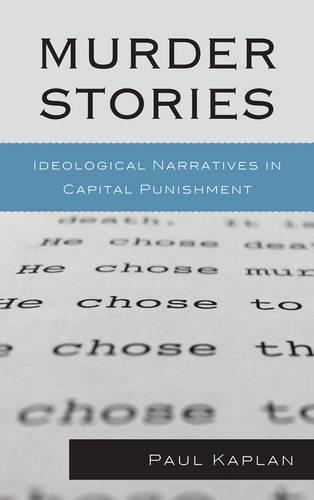
Книга Murder Stories: Ideological Narratives in Capital Punishment
Murder Stories engages with the current theoretical debate in death penalty research on the role of cultural commitments to ‘American’ ideologies in the retention of capital punishment. The central aim of the study is to illuminate the elusive yet powerful role of ideology in legal discourses. Through analyzing the content and processes of death penalty narratives, this research illuminates the covert life of ‘the American Creed,’ (a nexus of ideologies—liberty, egalitarianism, individualism, populism, and laissez faire—said to be unique to the United States) in the law. Murder Stories draws on the entire record of California death sentence resulting trials from three large and diverse California counties for the years 1996 – 2004, as well as interviews with 26 capital caseworkers (attorneys, judges, and investigators) from the same counties. Employing the theoretical framework proposed by Ewick and Silbey (1995) to study hegemonic and subversive narratives, and also the ethnographic approach advocated by Amsterdam and Hertz (1992) to study the producers and processes of constructing legal narratives, this book traces the ideological content carried within the stories told by everyday practitioners of capital punishment by investigating the content, process, and ideological implications of these narratives. The central theoretical finding is that the narratives constructed by both prosecutors and defenders tend to instantiate rather than subvert the ideological tenets of the American Creed.
"This is a study of the "murder stories" offered by participants in a large number of capital trials in California in the 1990s. Kaplan (San Diego State Univ.) explores how these accounts are framed so as to fit into widely held conceptions of justice within the American creed. The importance of these stories is literally a matter of life and death. To obtain a capital conviction or to avoid one, or to obtain a death sentence at a sentencing trial, both prosecutors and defense attorneys construct narratives that they hope will resonate with the jury. The prosecutor's task is to make the actions of the defendant "understandable" in ways that he or she is seen to be beyond redemption and thus subject to the death penalty. In turn the defense attorney must develop a script that humanizes the accused or offender so that while his behavior may be terrible, it is "understandable" in light of circumstances, and so that a modicum of mercy may be extended. This is a stunning book that shows the complexities and contradictions of capital punishment and at the same time reveals why capital punishment is so deeply ensconced in the American creed. Summing Up: Highly recommended." - CHOICE