Mostly Homonyms is a wonderful complement to the resources we use for our advanced learners of English as a second language in the university setting... -Leslie Grant, Ph.D., University of Colorado Many of my adult students, who present with various disabilities including autism spectrum disorder, are fascinated with words... -Jane Burke, M.A., co-author, The Planner Guide For our international students, the relationship between letters and the sounds the represent is anything but straightforward given the complexity of our spelling 'system'... -Steven A. Couture, Central Michigan University This textbook (Mostly Homonyms) will be extremely helpful for students in both my English and speech courses, particularly as a resource text... -Karol L. Walchak, Ph.D., Alpena Community College See continuation of comments on the last page of the book.
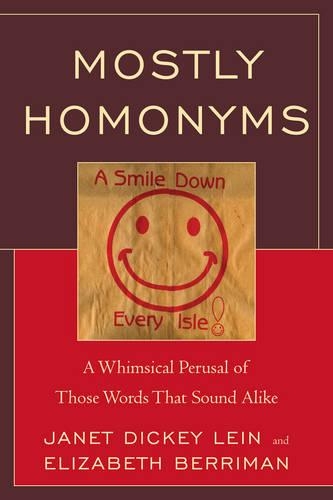
Homonyms are pairs of words (sometimes three or four words) that sound alike, but have different spellings and meanings, such as “side-sighed,” “bare-bear,” and “seen-scene.” This book has been written not only because homonyms pose a problem for many native speakers of English, but because they are also particularly troublesome for learners of English as a second language. This collection does not contain every homonym, but it does contain many of the most common ones.
Mostly Homonyms is a new treatment of a traditional topic that is easy to read and use without sacrificing academic relevance. It is intended not only for anyone who wishes to ascertain the correct spelling and usage of a homonym, whether non-native learners of English or native speakers of English, but also for people who just love words.