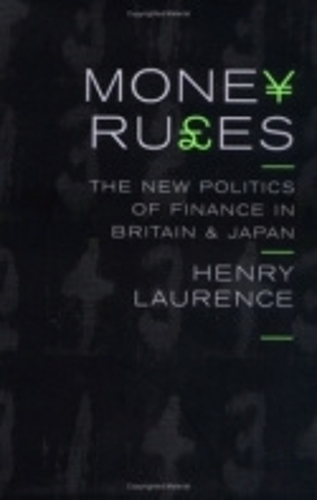
Книга Money Rules: The New Politics of Finance in Britain and Japan
Henry Laurence traces financial market reform in Britain and Japan over the last two decades, charting the movement of the Anglo-Saxon and Japanese styles of capitalism toward a new, hybrid form of economic organization. He explains what these two stories reveal about changes in the nature of business-government relations in an age of convergence.The package of reforms known in Britain as the "Big Bang" and in Japan as "Biggu Bangu" decontrolled prices, liberalized the number and nature of financial instruments that could be traded, opened both countries' markets to foreigners, and introduced a much greater degree of competition than would have been believed possible twenty years earlier. At the same time, Britain and Japan have undertaken stringent measures to improve the transparency and fairness of their markets.Why did two countries with traditionally very different regulatory styles adopt such strikingly similar reforms, and why did these reforms result in a mixture of deregulation in some areas and tighter control in others? In explaining these apparent contradictions, Laurence invokes the powerful domestic political impact of international capital mobility.Money Rules challenges the view that bureaucracy is the most powerful actor in the policymaking process. Using extensive interviews with more than one hundred policymakers and financial professionals in both countries, the author rebuts conventional wisdom. He argues that the events in Britain and Japan demonstrate striking crossnational convergence of political and economic institutions.
Henry Laurence traces financial market reform in Britain and Japan over the last two decades, charting the movement of the Anglo-Saxon and Japanese styles of capitalism toward a new, hybrid form of economic organization. He explains what these two stories reveal about changes in the nature of business-government relations in an age of convergence.
The package of reforms known in Britain as the "Big Bang" and in Japan as "Biggu Bangu" decontrolled prices, liberalized the number and nature of financial instruments that could be traded, opened both countries' markets to foreigners, and introduced a much greater degree of competition than would have been believed possible twenty years earlier. At the same time, Britain and Japan have undertaken stringent measures to improve the transparency and fairness of their markets.
Why did two countries with traditionally very different regulatory styles adopt such strikingly similar reforms, and why did these reforms result in a mixture of deregulation in some areas and tighter control in others? In explaining these apparent contradictions, Laurence invokes the powerful domestic political impact of international capital mobility.
Money Rules challenges the view that bureaucracy is the most powerful actor in the policymaking process. Using extensive interviews with more than one hundred policymakers and financial professionals in both countries, the author rebuts conventional wisdom. He argues that the events in Britain and Japan demonstrate striking crossnational convergence of political and economic institutions.
"
In this book, Henry Laurence analyses the political process that underlies the process of reform of the financial regulation in the United Kingdom and Japan, and proves that the new dynamic introduced has not ultimately benefited the main proponents of the reforms as it was intended.
" - Millennium: Journal of International Studies"
Laurence suggests that domestic politics was a necessary but not a sufficient condition for launching the major financial reforms undertaken in Japan. He doubts that many key Japanese financial reforms were accelerated by U.S. threat or coercion or that Japanese leaders and bureaucrats were suddenly converted by the wisdom of the American approach. Instead Laurence suggests that in both countries, the success of the U.S. model coupled with the onward creep of internationalization persuaded first Britain and then Japan to liberalize.
" - Comparative Politics