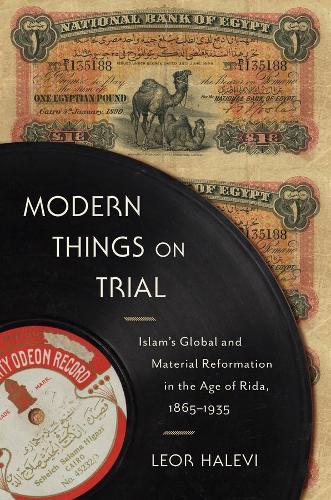
Книга Modern Things on Trial: Islam’s Global and Material Reformation in the Age of Rida, 1865–1935
In cities awakening to global exchange under European imperial rule, Muslims encountered all sorts of strange and wonderful new things—synthetic toothbrushes, toilet paper, telegraphs, railways, gramophones, brimmed hats, tailored pants, and lottery tickets. The passage of these goods across cultural frontiers spurred passionate debates. Realizing that these goods were changing religious practices and values, proponents and critics wondered what to outlaw and what to permit.
In this book, Leor Halevi tells the story of the Islamic trials of technological and commercial innovations of the late nineteenth and early twentieth centuries. He focuses on the communications of an entrepreneurial Syrian interpreter of the shariʿa named Rashid Rida, who became a renowned reformer by responding to the demand for authoritative and authentic religious advice. Upon migrating to Egypt, Rida founded an Islamic magazine, The Lighthouse, which cultivated an educated, prosperous readership within and beyond the British Empire. To an audience eager to know if their scriptures sanctioned particular interactions with particular objects, he preached the message that by rediscovering Islam’s foundational spirit, the global community of Muslims would thrive and realize modernity’s religious and secular promises.
Through analysis of Rida’s international correspondence, Halevi argues that religious entanglements with new commodities and technologies were the driving forces behind local and global projects to reform the Islamic legal tradition. Shedding light on culture, commerce, and consumption in Cairo and other colonial cities, Modern Things on Trial is a groundbreaking account of Islam’s material transformation in a globalizing era.
"An outstanding work that sets a new standard for the writing of modern Islamic intellectual history...this book will prove of enduring interest to researchers in Islamic law and modern Islamic thought, historians of the late imperial and early nation-state Muslim worlds, and students of the processes of globalization more generally." - American Journal of Islamic Social Sciences
"Halevi sheds light on Islam’s relationship with modernity by offering an account of how Islamic revivalists first responded to modern transformations through religious and legal rulings." - Middle East Journal
"This excellent book is paradigm shifting. . . Essential." - Choice
"Halevi’s work contributes to the larger understanding of how Islamic reform in this period was often driven through the
historical narrative of Riḍā as a reformer, illustrating a bottom-up process." - Arab Studies Quarterly
"A fresh, lively, and materialist intervention against reductive readings of modern Islam." - Jadaliyya
"By rejecting abstractions like “Westernization” and turning instead to how tangible things were weighed on the moral scale of sharia, Leor Halevi presents a bold and lucid new analysis of the making of modern Islam." - Los Angeles Review of Books
"Halevi’s book charts the way for other scholars of law and history to write history grounded in an eclectic mix of materials in several languages from various archives around the world." - Law and Social Inquiry
"Halevi’s compelling monograph is relevant to a large audience and should interest global historians and historians of empire as much as scholars of modern Islam." - American Historical Review
"He not only weaves intellectual and economic history together but comes forth with a contribution that is as ground breaking and original regarding the development of a consumer culture as it is concerning legal reform." - Bulletin of the School of Oriental and African Studies
"The writing is clear, engaging, and accessible. In addition to classes on Islam, the arguments advanced here
may be pertinent to courses on theory in religious studies." - International Journal of Middle East Studies
"It is a new way of looking at the issue of religion and modernity. Among other things, this book would be an excellent focus for graduates reading law and change in the modern Muslim world." - Technology and Culture