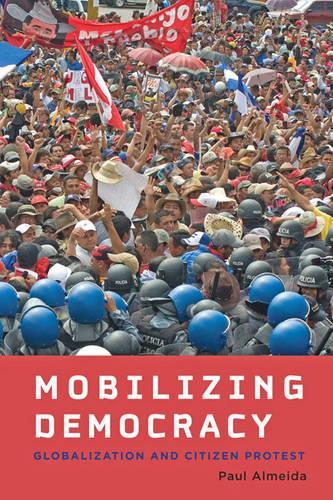
Книга Mobilizing Democracy: Globalization and Citizen Protest
By comparing local-level protests in countries of Central America during the time of neoliberal reforms, Almeida identifies some of the systematic connections between state structure, civil society organization, and patterns of protest. This is an excellent example of the use of comparative analysis to understand global processes. -- Jackie Smith, University of Pittsburgh The Central American region has long been neglected in studies of economic liberalization and the social and political responses to it. Paul Almeida fills that gap with this empirically-rich comparative analysis of protest campaigns against market-based globalization in the region. He also breaks new ground theoretically by examining the community-based sources of subnational variation in protest dynamics, and by exploring how multisectoral protest coalitions are forged. This is a much-needed addition to the literature on globalization and social protest, and it is essential reading for anyone who wants to understand the fault lines in Central America's postrevolutionary political orders. -- Ken Roberts, Cornell University Paul Almeida brilliantly brings Central America into the great debates about antineoliberal protest in Latin America. Even more importantly it makes a tremendous and much needed contribution to our understanding of how local protest scales up to national campaigns. -- Eduardo Silva, Tulane University Paul Almeida's pleasingly written Mobilizing Democracy unpacks the recent largely non-violent popular struggles against a new round of global capitalist integration in six Central American Nations. He accomplishes this by nesting the recent mobilizations into the comparative context of previous protest campaign mobilizations and each nation's evolving and flourishing civil society structures. Studies of protest mobilization don't get any better than this! -- John McCarthy, Penn State University Paul Almeida has done it again. Through a detailed analysis of over 4,000 separate protest events across Central America, Almeida uncovers the path-dependent processes that enable some anti-neoliberalization mobilizations to take off-and achieve important concessions-while other mobilization attempts flounder. By investigating the interaction between global forces and local contexts, Almeida provides a powerful corrective to existing anti-neoliberalization analyses, which focus heavily on the "global." In fact, he argues, local contexts powerfully influence when and how civil society organizations challenge-and sometimes defeat-neoliberal politics. In the process, Almeida also extends existing scholarly understandings of transnational activism, coalition formation, and the Latin American "Left." This stellar book is essential reading for anyone wishing to understand the complex relationship between globalization, civil society, development, and democracy. -- Jocelyn Viterna, Harvard University
Paul Almeida's comparative study of the largest social movement campaigns that existed between 1980 and 2013 in every Central American country (Costa Rica, El Salvador, Guatemala, Honduras, Nicaragua, and Panama) provides a granular examination of the forces that spark mass mobilizations against state economic policy, whether those factors are electricity rate hikes or water and health care privatization. Many scholars have explained connections between global economic changes and local economic conditions, but most of the research has remained at the macro level. Mobilizing Democracy contributes to our knowledge about the protest groups "on the ground" and what makes some localities successful at mobilizing and others less successful. His work enhances our understanding of what ingredients contribute to effective protest movements as well as how multiple protagonists-labor unions, students, teachers, indigenous groups, nongovernmental organizations, women's groups, environmental organizations, and oppositional political parties-coalesce to make protest more likely to win major concessions. Based on extensive field research, archival data of thousands of protest events, and interviews with dozens of Central American activists, Mobilizing Democracy brings the international consequences of privatization, trade liberalization, and welfare-state downsizing in the global South into focus and shows how persistent activism and network building are reactivated in these social movements. Almeida enables our comprehension of global and local politics and policy by answering the question, "If all politics is local, then how do the politics of globalization manifest themselves?" Detailed graphs and maps provide a synthesis of the quantitative and qualitative data in this important study. Written in clear, accessible prose, this book will be invaluable for students and scholars in the fields of political science, social movements, anthropology, Latin American studies, and labor studies.