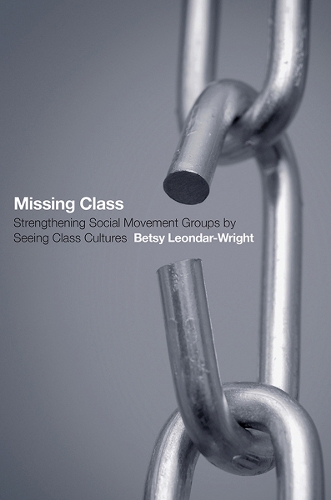
Книга Missing Class: Strengthening Social Movement Groups by Seeing Class Cultures
Many activists worry about the same few problems in their groups: low turnout, inactive members, conflicting views on racism, overtalking, and offensive violations of group norms. But in searching for solutions to these predictable and intractable troubles, progressive social movement groups overlook class culture differences. In Missing Class, Betsy Leondar-Wright uses a class-focused lens to show that members with different class life experiences tend to approach these problems differently. This perspective enables readers to envision new solutions that draw on the strengths of all class cultures to form the basis of stronger cross-class and multiracial movements.The first comprehensive empirical study of US activist class cultures, Missing Class looks at class dynamics in 25 groups that span the gamut of social movement organizations in the United States today, including the labor movement, grassroots community organizing, and groups working on global causes in the anarchist and progressive traditions. Leondar-Wright applies Pierre Bourdieu’s theories of cultural capital and habitus to four class trajectories: lifelong working-class and poor; lifelong professional middle class; voluntarily downwardly mobile; and upwardly mobile.Compellingly written for both activists and social scientists, this book describes class differences in paths to activism, attitudes toward leadership, methods of conflict resolution, ways of using language, diversity practices, use of humor, methods of recruiting, and group process preferences. Too often, we miss class. Missing Class makes a persuasive case that seeing class culture differences could enable activists to strengthen their own groups and build more durable cross-class alliances for social justice.
Many activists worry about the same few problems in their groups: low turnout, inactive members, conflicting views on racism, overtalking, and offensive violations of group norms. But in searching for solutions to these predictable and intractable troubles, progressive social movement groups overlook class culture differences. Missing Class looks through a class lens and discovers that members with different class life experiences tend to approach these problems differently. Using this class lens enables readers to envision new solutions, solutions that draw on the strengths of all class cultures to form the basis of stronger cross-class and multiracial movements.
In Missing Class, the first comprehensive empirical study of US activist class cultures, Betsy Leondar-Wright looks at class dynamics in twenty-five groups that span the spectrum of social movement organizations in the United States today, including the labor movement, grassroots community organizing, and groups working on global causes in the anarchist and progressive traditions. Missing Class applies Pierre Bourdieu’s theories of cultural capital and habitus to four class trajectories: lifelong working-class and poor; lifelong professional middle class; voluntarily downwardly mobile; and upwardly mobile.
Compellingly written for both activists and social scientists, Missing Class describes class differences in paths to activism, attitudes toward leadership, methods of conflict resolution, ways of using language, diversity practices, use of humor, methods of recruiting, and group process preferences. Too often, we miss class. Missing Class makes a persuasive case that seeing class culture differences could enable activists to strengthen their own groups and build more durable cross-class alliances for social justice.
"
Betsy Leondar-Wright's book is crucially important for social justice activists. She offers much-needed advice about how to acknowledge your class background and harness it for the greater good. Eye-opening and insightful, this book provides a new way forward.
" - The Progressive"
From fashion sense to senses of humor, Missing Class illustrates the subtle cues in which class disparities manifest within activist groups. In a context where class is sometimes conspicuously missing from our stories, this is a welcome reminder to put it back in.
" - Mobilization"
I cannot recommend Missing Class too highly. Some books stimulate you intellectually.... Some books deepen awareness.... Some books are practical.... It's rare to find a book that does one of these things well. A book that does all three, brilliantly, is beyond rare. It’s a historical event.
" - Peace News"
Leondar-Wright's Missing Classis by far the best book available on the touchy subject of 'classism' since her own previous work,Class Matters: Cross-class Alliance Building for Middle Class Activist, and Fred Rose's incisive 1999 study,Coalitions across the Class Divide: Lessons from the Labor, Peace, and Environmental Movements, also published by Cornell. Like Rose before her, the author illustrates what bridges the divide—and what doesn't—within left-liberal groups and the broader, more diverse coalitions we need to alter power relationships in the United States.
" - The Labor Studies Journal"
The book's greatest virtue is that it makes a strong case that class cultures do create substantial barriers among activists and can undermine their groups’ efficacy. Anyone working with people of varying class back-grounds will appreciate the material presented in this book....Missing Class is a well-done book and a fine contribution to the study of social class in politics, and I hope that it will be a stepping stone for a new generation of research on activist groups that links internal processes with tangible outcomes.
" - Administrative Science Quarterly