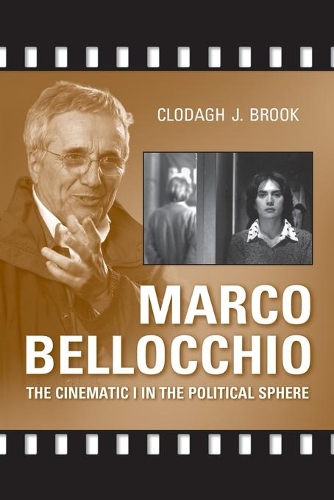
Книга Marco Bellocchio: The Cinematic I in the Political Sphere
'Marco Bellocchio's recent return to the centre-stage of Italian cinema has been nothing short of remarkable. Clodagh J. Brook's study-the first of Bellocchio in English-is a highly timely contribution, a vigorous and closely attentive account of his oeuvre to date. It describes a body of work, from I pugni in tasca (1965) through to Vincere (2009), poised at a series of challenging junctures, between the real and the oneiric, the personal and the political, in disquieting, compelling rebellion.' -- Robert S.C. Gordon, Department of Italian, University of Cambridge 'While Marco Bellocchio's film career has received deserved attention in Italy, his work is much less well known and written about in English. Clodagh J. Brook's admirably researched book redresses that situation by covering the span of his films from his earliest productions to the most recent, situating them in a historical, social, political, and theoretical context, and by paying proper attention to the changing forms of his style, his sources, modes of narration, and their connection to and divergence from those of other Italian and European filmmakers.' -- Marcia Landy, English and Film Studies, University of Pittsburgh
Marco Bellocchio is one of Italy's most important and prolific directors, with a career spanning five decades. In this book, Clodagh J. Brook explores the boundaries between the public and the private, the political and the personal, and the collective and the individual as they appear in Bellocchio's films. Including work on psychoanalysis, politics, film production, autobiography, and the relationship between film tradition and contemporary culture, Marco Bellocchio touches on fundamental issues in film analysis.
Brook's study interrogates what it means to make personal or anti-institutional art in a medium dominated by a late-capitalist industrial model of production. Her readings of Bellocchio's often enigmatic and perplexing work suggest new ways to answer questions about subjectivity, objectivity, and political commentary in modes of filmmaking. Relating the art of a private director to a public medium, Clodagh J. Brook's work is an important contribution to our understanding of film.