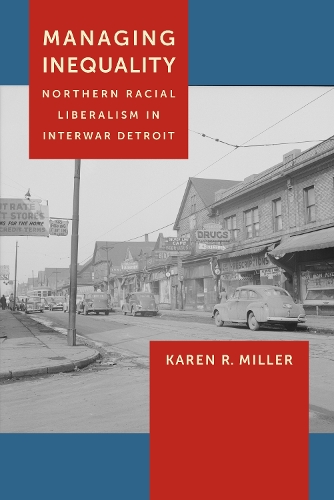
Книга Managing Inequality: Northern Racial Liberalism in Interwar Detroit
In Managing Inequality, Karen R. Miller examines the formulation, uses, and growing political importance of northern racial liberalism in Detroit between the two World Wars.
In the wake of the Civil War, many white northern leaders supported race-neutral laws and anti-discrimination statutes. These positions helped amplify the distinctions they drew between their political economic system, which they saw as forward-thinking in its promotion of free market capitalism, and the now vanquished southern system, which had been built on slavery. But this interest in legal race neutrality should not be mistaken for an effort to integrate northern African Americans into the state or society on an equal footing with whites. During the Great Migration, which brought tens of thousands of African Americans into Northern cities after World War I, white northern leaders faced new challenges from both white and African American activists and were pushed to manage race relations in a more formalized and proactive manner.
The result was northern racial liberalism: the idea that all Americans, regardless of race, should be politically equal, but that the state cannot and indeed should not enforce racial equality by interfering with existing social or economic relations. Miller argues that racial inequality was built into the liberal state at its inception, rather than produced by antagonists of liberalism. Managing Inequality shows that our current racial system—where race neutral language coincides with extreme racial inequalities that appear natural rather than political—has a history that is deeply embedded in contemporary governmental systems and political economies.
"With crisp prose and an expert use of historical evidence, Karen R. Miller makes a valuable contribution to our understanding of the intersections between early twentieth-century urban history and U.S. racial discourses." - Journal of American History
"Examines the transformation, uses, and growing political importance of northern racial liberalism, the notion that all Americans should be politically equal but that the state should not enforce racial equality by interfering with existing social or economic relations." - Journal of Economic Literature
"In her captivating study of interwar Detroit, Karen Miller sets out to uncover the origins of color-blind racism. Color-blind racism, she argues, is key to understanding modern American politics but is itself not properly understood. In particular, its historical originshave often been misconstrued by historians of the postwar period." - Labor
"With her tightly woven narrative about interwar Detroit, Miller offers an important contribution to the literature on the struggle for civil rights in the North." - Against the Current
"In her work,Managing Inequality, Karen R. Miller unearths the roots of modern colorblind discourse." - American Historical Review