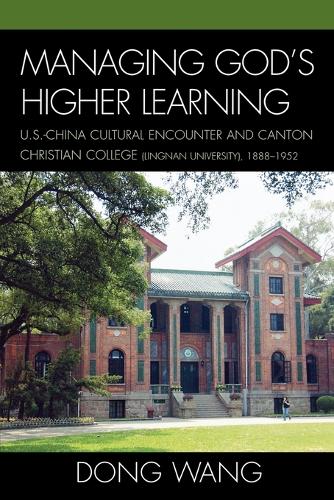
Книга Managing God's Higher Learning: U.S.-China Cultural Encounter and Canton Christian College (Lingnan University), 1888-1952
Managing GodOs Higher Learning offers a distinct empirical study of Lingnan University and addresses issues of adaptation and integration. Author, Dong Wang, demonstrates that many aspects of Lingnan _ governance, links with the local society, financial management, education for women _ have either never been made the subject of scholarly discussion or are different from what we think we know about U.S.-China relations in the past. As the first co-educational institution of higher learning in China, Lingnan made monumental strides in the management of programs for women, a fact which confounds the assumptions made by China historians. The author argues that LingnanOs growth, resilience and success can partly be accounted for by entrepreneurial operations. Wang also contends that Lingnan found ways to adapt and 'layer' a Christian presence at a time when the nationalization and secularization of higher education was making rapid headway. Based on information from archives located across the Pacific, this book will appeal to scholars of Chinese history as well as those interested in Sino-American relations.
"[Wang's] work is based on extensive research in libraries and archives on both sides of the Pacific Ocean, utilizing Chinese and English language sources. . . . She is to be commended for this publication, and it is to be hoped that not only will this work receive a wide readership but the issues presented by it will also encourage other scholars to pursue similar understudied themes." - The China Journal
"Wang's attention to the mutual interactions between nations and local places is to be applauded, as is her attention to the exceptional nature of Canton Christian College among the Christian colleges as a truly Sino-American venture in funding, staffing and student body, from the beginning." - Pacific Affairs
"Managing God's Higher Learning has filled a gap in the study of Christian institutions of higher education in China by providing new archival evidence and offering a different perspective. The author's arguments regarding cultural encounters may lead to thoughtful discussions on how a receiving culture can benefit from this encounter." - China Review International