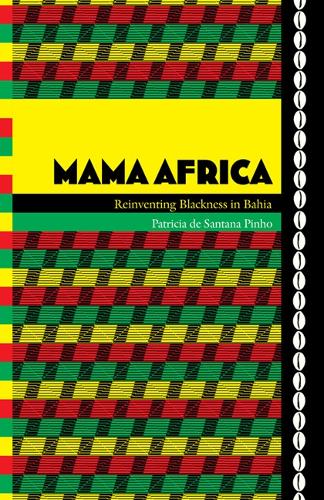
Книга Mama Africa: Reinventing Blackness in Bahia
Analyzes attitudes towards Africa within musical cultural groups in Salvador, Bahia and the attitudes of African Americans who engage with these groups, and with Afro-Bahian cultural generally, in what is called "roots tourism."
Often called the “most African” part of Brazil, the northeastern state of Bahia has the country’s largest Afro-descendant population and a black culture renowned for its vibrancy. In Mama Africa, Patricia de Santana Pinho examines the meanings of Africa in Bahian constructions of blackness. Combining insights from anthropology, sociology, and cultural studies, Pinho considers how Afro-Bahian cultural groups, known as blocos afro, conceive of Africanness, blackness, and themselves in relation to both. Mama Africa is a translated, updated, and expanded edition of an award-winning book published in Brazil in 2004. Central to the book, and to Bahian constructions of blackness, is what Pinho calls “the myth of Mama Africa,” the idea that Africa exists as a nurturing spirit inside every black person.
Pinho explores how Bahian cultural production influences and is influenced by black diasporic cultures and the idealization of Africa—to the extent that Bahia draws African American tourists wanting to learn about their heritage. Analyzing the conceptions of blackness produced by the blocos afro, she describes how Africa is re-inscribed on the body through clothes, hairstyles, and jewelry; once demeaned, blackness is reclaimed as a source of beauty and pride. Turning to the body’s interior, Pinho explains that the myth of Mama Africa implies that black appearances have corresponding black essences. Musical and dance abilities are seen as naturally belonging to black people, and these traits are often believed to be transmitted by blood. Pinho argues that such essentialized ideas of blackness render black culture increasingly vulnerable to exploitation by the state and commercial interests. She contends that the myth of Mama Africa, while informing oppositional black identities, overlaps with a constraining notion of Bahianness promoted by the government and the tourist industry.
"“[A] fresh and welcome perspective. . . . The greatest contribution offered by this book is the subtle but forceful engagement with Diaspora theorists, Brazilianist scholarship on race and mestic¸agem (a Portuguese cognate for mestizaje), and the increasingly specific and fraught language of public policy debates in Brazil.”" - American Anthropologist
"“In this provocative work, the author clearly stands for a new black political culture that dares to go beyond the notions of blackness and whiteness. . . . The excellent work of Pinho vividly demonstrates that meanings of blackness and whiteness should be examined both in local and global contexts. . . .”" - A Contracorriente
"“Pinho favors detailed and measured presentation of an idea, term or argument, followed by an equally in-depth and careful critique. Her book is a breath of fresh air. . . .”" - Cultural Studies Review
"“This book makes an important, sophisticated, and bold contribution and is especially apt for scholars of the social construction of race/ethnicity/nation.”" - Contemporary Sociology
"“This translation of Patricia Pinho's Mama Africa is a timely and welcome addition to the scholarship on racial identity in Brazil and will be useful as an English-language teaching resource in courses about Brazil, race, and the Atlantic World. . . . [T]his is a sharp study and an able translation that should hold an important place in the tools available for helping students outside Brazil understand that country's fascinating politics of racial identity.”" - EIAL