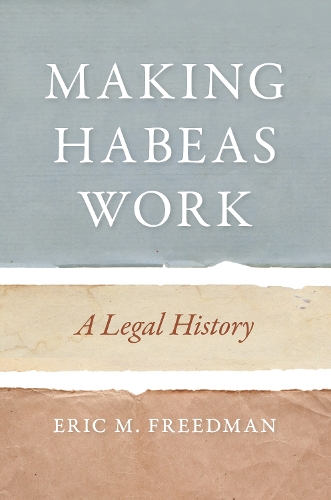
Книга Making Habeas Work: A Legal History
A reconsideration of the writ of habeas corpus casts new light on a range of current issues
Habeas corpus, the storied Great Writ of Liberty, is a judicial order that requires government officials to produce a prisoner in court, persuade an independent judge of the correctness of their claimed factual and legal justifications for the individual’s imprisonment, or else release the captive. Frequently the officials resist being called to account. Much of the history of the rule of law, including the history being made today, has emerged from the resulting clashes.
This book, heavily based on primary sources from the colonial and early national periods and significant original research in the New Hampshire State Archives, enriches our understanding of the past and draws lessons for the present.
Using dozens of previously unknown examples, Professor Freedman shows how the writ of habeas corpus has been just one part of an intricate machinery for securing freedom under law, and explores the lessons this history holds for some of today’s most pressing problems including terrorism, the Guantanamo Bay detentions, immigration, Brexit, and domestic violence.
Exploring landmark cases of the past - like that of John Peter Zenger - from new angles and expanding the definition of habeas corpus from a formal one to a functional one, Making Habeas Work brings to light the stories of many people previously overlooked (like the free black woman Zipporah, defendant in “the case of the headless baby”) because their cases did not bear the label “habeas corpus.”
The resulting insights lead to forward-thinking recommendations for strengthening the rule of law to insure that it endures into the future.
"An interesting question is whether history can truly prove anything about the validity of an individual court decision today, even if common-law practice is based on precedents. We know of a number of “precedents” once set by the Supreme Court that have since been overturned by that same Court because the common American understanding of decent social norms has changed over time. Be that as it may, Eric M. Freedman narrates dozens of cases since the colonial era, some in considerable detail, as related to habeas corpus or to a number of other legal proceedings by which the legality of detentions by local and government officials have been protested, prosecuted, and occasionally rejected in court, with fines levied." - Journal of American History
"Focusing on the early history of habeas, and bringing it into dialogue with contemporary struggles, [Freedman] recaptures a lost history of legal remedies that functioned to free aggrieved individuals from the states coercive power." - Tulsa Law Review
"This impressive work of scholarship by one of the leading national experts on habeas corpus draws deeply on history to expand and enrich the modern understanding of the writ. The book is an invaluable resource for legal scholars, the judiciary, and the practicing bar. Its insights will almost certainly surprisereaders, just as they have surprised and informed us notwithstanding our long immersion in the topic." - (LexisNexis 7th ed. & annual supplements)
"Professor Eric Freedman charts a new habeas path: one that goes both backward and forward... Freedman uncovers a largely ignored history of habeas corpus. Armed with this broader understanding of habeas’s past... judges and scholars will be better equipped to chart its future." - Harvard Law Review
"As Professor Freedman demonstrates, sometimes judges do not ignore history to reach their goal—they rewrite it." - Westlaw