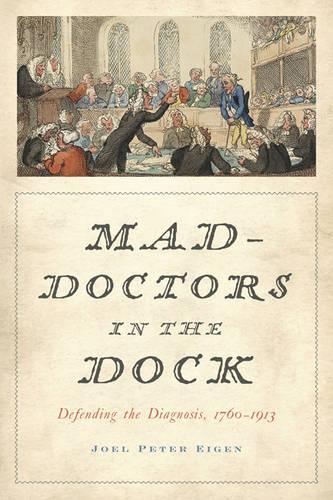
Книга Mad-Doctors in the Dock: Defending the Diagnosis, 1760–1913
Eigen exploits detailed courtroom narratives from the Old Bailey Sessional papers to give us a colorful and gripping sense of the life-and-death maneuvers involved in mounting an insanity defense. Placing forensic psychiatry into a much broader social, cultural, and intellectual context, Mad-Doctors in the Dock is an excellent, accessible, and well-written account. -- Andrew Scull, University of California, San Diego, author of Madness in Civilization: A Cultural History of Insanity from the Bible to Freud, from the Madhouse to Modern Medicine From the crime scene through the trial, Mad-Doctors in the Dock connects for the first time the evolution of the insanity doctrine, the judicial management of the trial, and the place of medical practitioners' diagnoses of defendants within the administration of the criminal law. A wise and original work-both foundational and indispensable. -- Thomas Green, University of Michigan, author of Freedom and Criminal Responsibility in American Legal Thought The product of close and careful research covering hundreds of trials, Mad-Doctors in the Dock brings to life the ideas, the actors, and the drama in the development of medico-legal diagnoses such as homicidal mania. A valuable resource for legal scholars and historians and sociologists of madness and crime. -- Arlie Loughnan, Faculty of Law, University of Sydney, author of Manifest Madness: Mental Incapacity in Criminal Law
Shortly before she pushed her infant daughter headfirst into a bucket of water and fastened the lid, Annie Cherry warmed the pail because, as she later explained to a police officer, "It would have been cruel to put her in cold water." Afterwards, this mother sat down and poured herself a cup of tea. At Cherry's trial at the Old Bailey in 1877, Henry Charlton Bastian, physician to the National Hospital for the Paralyzed and Epileptic, focused his testimony on her preternatural calm following the drowning. Like many other late Victorian medical men, Bastian believed that the mother's act and her subsequent behavior indicated homicidal mania, a novel species of madness that challenged the law's criterion for assigning criminal culpability. How did Dr. Bastian and his cohort of London's physicians, surgeons, and apothecaries-originally known as "mad-doctors"-arrive at such an innovative diagnosis, and how did they defend it in court? Mad-Doctors in the Dock is a sophisticated exploration of the history of the insanity defense in the English courtroom from the middle of the eighteenth century to the early twentieth century. Joel Peter Eigen examines courtroom testimony offered in nearly 1,000 insanity trials, transporting us into the world of psychiatric diagnosis and criminal justice. The first comprehensive account of how medical insight and folk psychology met in the courtroom, this book makes clear the tragedy of the crimes, the spectacle of the trials, and the consequences of the diagnosis for the emerging field of forensic psychiatry.