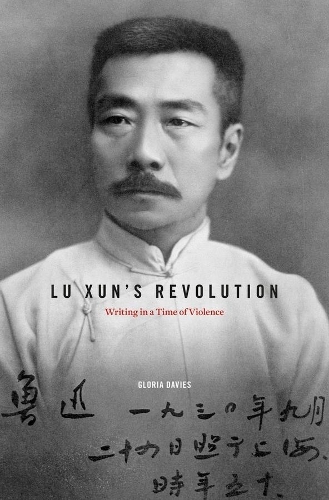
Книга Lu Xun's Revolution: Writing in a Time of Violence
Widely recognized as modern China’s preeminent man of letters, Lu Xun (1881–1936) is revered as the voice of a nation’s conscience, a writer comparable to Shakespeare and Tolstoy in stature and influence. Gloria Davies’s portrait now gives readers a better sense of this influential author by situating the man Mao Zedong hailed as “the sage of modern China” in his turbulent time and place.
In Davies’s vivid rendering, we encounter a writer passionately engaged with the heady arguments and intrigues of a country on the eve of revolution. She traces political tensions in Lu Xun’s works which reflect the larger conflict in modern Chinese thought between egalitarian and authoritarian impulses. During the last phase of Lu Xun’s career, the so-called “years on the left,” we see how fiercely he defended a literature in which the people would speak for themselves, and we come to understand why Lu Xun continues to inspire the debates shaping China today.
Although Lu Xun was never a Communist, his legacy was fully enlisted to support the Party in the decades following his death. Far from the apologist of political violence portrayed by Maoist interpreters, however, Lu Xun emerges here as an energetic opponent of despotism, a humanist for whom empathy, not ideological zeal, was the key to achieving revolutionary ends. Limned with precision and insight, Lu Xun’s Revolution is a major contribution to the ongoing reappraisal of this foundational figure.
"The range of Davies' research is staggering, and her erudition is impressive as she glides through Lu Xun's literary career. She deals frankly and comprehensively with Lu Xun's most prominent critics and notes how he handled them with intensity and agility. She has much to say, as well, about his theories of writing--how he decried political rhetoric, despised romantic fiction and saw the moral ambiguity of revolutionary writing. She also reproduces his list of eight tips for aspiring writers." - Kirkus Reviews
"In Lu Xun's Revolution, Davies has created a fascinating account of the final years of the writer's life and the beginning of his literary afterlife." - Wall Street Journal
"A groundbreaking work." - Times Higher Education
"For those who would like to find out about Lu Xun there is plenty of information in this copious literary and political biography...Lu Xun's Revolution is a formidable book." - Literary Review
"This richly documented study of China’s pre-eminent writer Lu Xun (1881-1936) by Gloria Davies cannot fail to provoke deep reflection on the issue of the creative writer, artist, philosopher, or scholar and his or her involvement in politics." - Australian Book Review