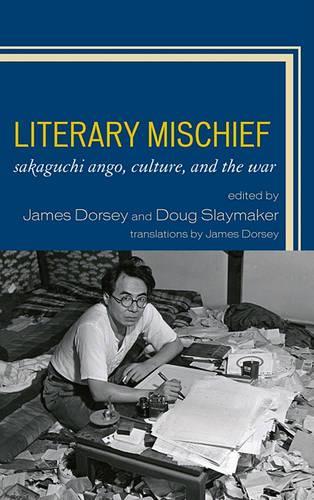
Книга Literary Mischief: Sakaguchi Ango, Culture, and the War
Sakaguchi Ango (1906-1955) was a writer who thrived on iconoclasm and agitation. He remains one of the most creative and stimulating thinkers of twentieth-century Japan. Ango was catapulted into the public consciousness in the months immediately following Japan's surrender to the Allied Forces in 1945. The energy and iconoclasm of his writings were matched by the outrageous and outsized antics of his life. Behind that life, and in the midst of those tumultuous times, Ango spoke with a cutting clarity. The essays and translations included in Literary Mischief probe some of the most volatile issues of culture, ideology, and philosophy of postwar Japan. Represented among the essayists are some of Japan's most important contemporary critics (e.g., Karatani K?jin and Ogino Anna). Many of Ango's works were produced during Japan's wars in China and the Pacific, a context in which words and ideas carried dire consequences for both writers and readers. All of the contributions to this volume consider this dimension of Ango's legacy, and it forms one of the thematic threads tying the volume together. The essays use Ango's writings to situate his accomplishment and contribute to our understanding of the potentials and limitations of radical thought in times of cultural nationalism, war, violence, and repression. This collection of essays and translations takes advantage of current interest in Sakaguchi Ango's work and makes available to the English-reading audience translations and critical work heretofore unavailable. As a result, the reader will come away with a coherent sense of Ango the individual and the writer, a critical apparatus for evaluating Ango, and access to new translations of key texts.
"This volume explores the historical moment and literary genius of a member of the Japanese literati who is little known in the West. Part 1 comprises five judicious essays and an introduction, in which Dorsey explicates the several representative writings by Ango (1906-55) presented in translation in part 2. Ango's penchant for iconoclasm and irreverence for things "traditional" is revealed in his "Discourse on Decadence" (1946), which earned him his literary reputation in postwar Japan. An unflinchingly honest cultural critic, Ango remained independent of political ideology throughout a historical period noted for its severe upheavals. A joyous iconoclast with an insatiable appetite for life and a fondness for farcical extremes, Ango sometimes blurred the boundaries of genre with his writing, which defies categorization in any Japanese literary school. He was considered a buraiha, "libertine," by default, and his life and works are distinguished by rebellion (against form and convention) and passion; he believed literature represented the entire human experience. This excellent book is a welcome addition to Japanese literary criticism. Highly recommended." - CHOICE, November 2010
"Homing in on the author’s deliberate juxtaposition of individual and cultural identity formation Because they successfully made the case for reconsideration of Ango’s oeuvre, one hopes the editors will continue with this endeavor in their ongoing research Ango’s predilection for inverting or dismantling a series of binary oppositions hitherto viewed as inviolable that leaps off the pages In a carefully constructed thesis, James Dorsey goes to the heart of the debate on literary complicity Dorsey’s close reading of “Shinju,” read as it is through the prism of Ango’s hallmark “Daraku-ron,” is indeed refreshing-as is his conclusion that, for all the conflicting interpretations of the work, “all is not lost.” What we have here, in short, is a long-awaited “Ango reader,” a collection that will be of interest to a wide range of Japan hands and one that provides plenty of scope and ideas for further investigation" - The Journal of Japanese Studies