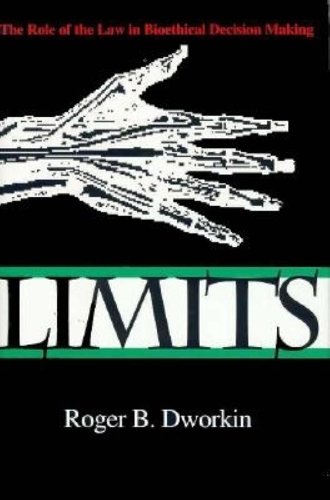
Книга Limits: The Role of the Law in Bioethical Decision Making
A Choice Outstanding Academic Book of 1997
An argument against quick-fix legal and legislative solutions to the difficult ethical problems created by advances in biomedicine.
"An excellent resource for entry-level courses on bioethics for health care practitioners, law students, and physicians." —Choice
"Dworkin's provocative arguments . . . will challenge readers who have come to accept the law's intrusion as a necessary response to biomedical advances." —New England Journal of Medicine
"Important and refreshing. Dworkin's conclusions regarding the limited role of law (and especially legislation) may come as a surprise to many. . . . When popular and political views are almost evenly divided, looking to legislation for a solution is a mistake." —Walter Wadlington
The ethical and social dilemmas associated with abortion, sterilization, assisted reproduction, genetics, death and dying, and biomedical research have led many to turn to the legal system for solutions. Rogert Dworkin argues that resort to law often overlooks the limitations of legal institutions, and he suggests a more limited use of the legal system will produce more effective resolution of bioethical dilemmas.
"
As ethical and social dilemmas mount with an advancing technology, so also have people turned to the legal system for solutions. Dworkin examines the basis of why biomedical and healthcare decisions more often end up in courts of law. The author does a masterful job of reviewing the present US legal system when it comes to bioethical decision making. In fact, the first chapter reviews the legal, legislative, and constitutional aspects of this issue. The information is clearly presented to provide readers with a new insight into what is happening. Seven chapters touch all of the hot point issues in bioethics: abortion, sterilization, alternative reproduction techniques, genetic screening, death and dying, and human research; the final chapter offers conclusions from this study. Dworkin makes it clear that use of the legal system in this area is unwarranted in most cases and that there exist alternatives for decision making in difficult bioethics cases. An excellent resource for entry-level courses on bioethics for health care practitioners, law students, and physicians. Upper-division undergraduate and graduate students; faculty; professionals.June 1997
" - Walters State Community College