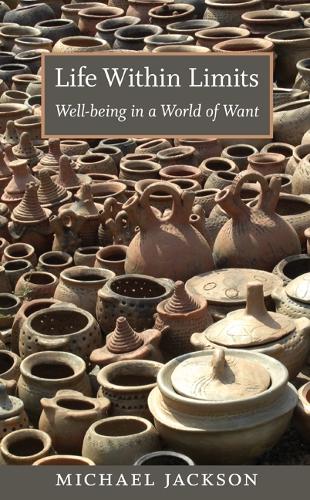
Книга Life Within Limits: Well-being in a World of Want
Noted anthropologist Michael Jackson examines the problem of well-being and the question as to what makes life worthwhile
The sense that well-being remains elusive, transitory, and unevenly distributed is felt by the rich as well as the poor, and in all societies. To explore this condition of existential dissatisfaction, the anthropologist Michael Jackson traveled to Sierra Leone, described in a recent UN report as the “least livable” country in the world. There he revisited the village where he did his first ethnographic fieldwork in 1969–70 and lived in 1979. Jackson writes that Africans have always faced forces from without that imperil their lives and livelihoods. Though these forces have assumed different forms at different times—slave raiding, warfare, epidemic illness, colonial domination, state interference, economic exploitation, and corrupt government—they are subject to the same mix of magical and practical reactions that affluent Westerners deploy against terrorist threats, illegal immigration, market collapse, and economic recession. Both the problem of well-being and the question of what makes life worthwhile are grounded in the mystery of existential discontent—the question as to why human beings, regardless of their external circumstances, are haunted by a sense of insufficiency and loss. While philosophers have often asked the most searching questions regarding the human condition, Jackson suggests that ethnographic method offers one of the most edifying ways of actually exploring those questions.
"“Michael Jackson is one of contemporary anthropology’s consummate storytellers.... In this case, Jackson’s theme is the existential discontent that human beings wrestle with as they attempt to define, and live, a fulfilling and hopeful life.... How do the pressures of poverty in a world now defined by the money economy shape the aspirations of individuals and communities?... Given the diversity of ways in which human beings deal with a similar set of existential problems, philosophy for Jackson is best done with the tools of ethnography and by serious immersion in the minutiae of different ways of being human.... For both aspiring and veteran ethnographers, Jackson’s stories are poignant examples of how human a science anthropology can be.”" - Journal of Anthropological Research
"“Reading Michael Jackson’s remarkable book reaffirmed my belief in the remarkable human capacity for social resilience. Such resilience enables us to experience a measure of well-being—even in a context of want. Unlike most books that focus on anthropological subjects, this one compels us to think about big questions—themes that shape the human condition. As such, Life within Limits is a gift to us all.” " - American Ethnologist
"“Life Within Limits skillfully blends history, philosophy and travel memoir to address a contemporary development problem: How can people achieve well-being in a world of finite resources?”" - Progress in Development Studies
"“This is the work of an elder, literary and philosophical, yet the style is personal, anecdotal, and impressionistic…. One former renegade Jackson encounters… serves as a briefly glimpsed symbol of separation from others and from the deeper cultural sensibility that Jackson explores so gracefully in this book.” " - Africa
"“Jackson weaves effortlessly between the raw details of life in Sierra Leone and the musings of Western writers and philosophers, and he brings to light how, in spite of the immediate differences of detail in humanity’s daily struggles, the underlying themes of dissatisfaction and hope are resonant.”" - Current Anthropology
"“In sum, Jackson provides a compelling and eloquent alternative account of ‘the good life’ as lived in Firawa, as temporally deep as it is ethnographically evocative. More than a corrective to current popular, academic, and development discourses on ‘quality of life’ in Sierra Leone, Life Within Limits explores recent social transformations wrought by civil conflict, migration, and growing inequality… without reducing lived experience to these analytical categories."" - Journal of Religion in Africa