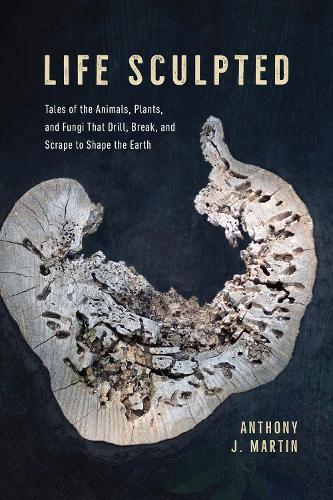
Книга Life Sculpted: Tales of the Animals, Plants, and Fungi That Drill, Break, and Scrape to Shape the Earth
"There is much to love between this book’s covers. . . . There are many eureka moments in Life Sculpted—and some truly beautiful ones."—Eugenia Bone, Wall Street Journal
Meet the menagerie of lifeforms that dig, crunch, bore, and otherwise reshape our planet.
Did you know elephants dig ballroom-sized caves alongside volcanoes? Or that parrotfish chew coral reefs and poop sandy beaches? Or that our planet once hosted a five-ton dinosaur-crunching alligator cousin? In fact, almost since its fascinating start, life was boring. Billions of years ago bacteria, algae, and fungi began breaking down rocks in oceans, a role they still perform today. About a half-billion years ago, animal ancestors began drilling, scraping, gnawing, or breaking rocky seascapes. In turn, their descendants crunched through the materials of life itself—shells, wood, and bones. Today, such “bioeroders” continue to shape our planet—from the bacteria that devour our teeth to the mighty moon snail, always hunting for food, as evidenced by tiny snail-made boreholes in clams and other moon snails.
There is no better guide to these lifeforms than Anthony J. Martin, a popular science author, paleontologist, and co-discoverer of the first known burrowing dinosaur. Following the crumbs of lichens, sponges, worms, clams, snails, octopi, barnacles, sea urchins, termites, beetles, fishes, dinosaurs, crocodilians, birds, elephants, and (of course) humans, Life Sculpted reveals how bioerosion expanded with the tree of life, becoming an essential part of how ecosystems function while reshaping the face of our planet. With vast knowledge and no small amount of whimsy, Martin uses paleontology, biology, and geology to reveal the awesome power of life’s chewing force. He provokes us to think deeply about the past and present of bioerosion, while also considering how knowledge of this history might aid us in mitigating and adapting to climate change in the future. Yes, Martin concedes, sometimes life can be hard—but life also makes everything less hard every day.
"It is often said that life changes the environment. But after reading Martin’s Life Sculpted, it seems more accurate to say that living changes the environment. It was true of the dinosaur era, and it remains true today. . . . For readers who are fascinated by living fossils such as bryozoans and horseshoe crabs, there is much to love between this book’s covers. . . . There are many eureka moments in Life Sculpted—and some truly beautiful ones. . . . The key takeaway of Life Sculpted, and ichnology more generally, is that geology is indistinguishable from biology. A prevailing theme in popular culture these days is that all life is connected. But what Martin implies is that it is not only biotic organisms that are interdependent, but the geological and chemical systems of the planet, too. And while the gap between the biotic and abiotic worlds may seem huge, it’s the science that’s complicated. So, while Life Sculpted is not everybody’s idea of beach reading, think of it this way: It’s the beach." - Wall Street Journal
"A sampling of chapter headings in Life Sculpted: 'A Boring History of Life,' 'More Bones to Pick' and—most memorably—'Your Beach is Made of Parrotfish Poop.' Ever the tuned-in observer, Martin once noticed a sound while snorkeling, 'a crunching and popping reminiscent of sugary breakfast cereals meeting milk.' Fish, he discovered, were chowing down on the reef and then ejecting sand. Some sedimentary cycles later, we get a postcard-worthy playground. And don’t get him started on starfish: 'If you ever find a wayward sea star or other echinoderm near a beach, whatever you do, do not put it in freshwater, as this will surely kill it,' he writes. 'The same principle applies to keeping it on a shelf at home, or wearing one as a sheriff badge, which will quickly become a stinking badge, which you do not need.' You groan, but will you forget that image?" - Atlanta Journal-Constitution
"A bewildering array of lifeforms break, scrape, and mold our planet to their own ends, from elephants digging caves by volcanoes to bacteria breaking down rocks in the oceans. Bioerosion is a distinct area of science, covering paleontology, biology, and geology. It's also testament to how life adapts to change, something relevant in the current Anthropocene era." - Bookseller
"Much of Martin's discussion involves ichnology, the study of trace fossils, such as tracks, burrows, bite marks, holes. He describes how snails drill into their prey, pine beetles munch trees, otters use rocks as tools to bust clam shells, and stingrays emit high pressure jets of water to expose quarry hiding in sediment. Martin’s writing is witty, rich in facts (the teeth of beavers are enhanced with iron), and spiced with eclectic references, such as the films Jurassic Park, Alien, and Jaws, authors ranging from Aeschylus to H.P. Lovecraft, and TV shows House Hunters and Breaking Bad. Mingling geology, biology, and paleontology, Martin has fashioned a unique and engaging portrait of the earth's many movers and shakers." - Booklist