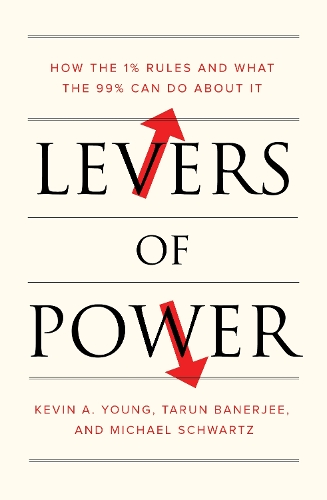
Книга Levers of Power: How the 1% Rules and What the 99% Can Do About It
Understanding the power of the corporations and how to take the struggle directly to them.
It's no secret that the 1%-the business elite that commands the largest corporations and the connected network of public and private institutions-exercise enormous control over the US government. While this control is usually attributed to campaign donations and lobbying, Levers of Power argues that corporate power derives from control over the economic resources on which daily life depends. Government officials must constantly strive to keep capitalists happy, lest they go on "capital strike"-that is, refuse to invest in particular industries or locations, or move their holdings to other countries-and therefore impose material hardship on specific groups or the economy as a whole. For this reason, even politicians who are not dependent on corporations for their electoral success must fend off the interruption of corporate investment. Levers of Power documents the pervasive power of corporations and other institutions with decision-making control over large pools of capital, particularly the Pentagon. It also shows that the most successful reform movements in recent US history-for workers' rights, for civil rights, and against imperialist wars-succeeded by directly targeting the corporations and other institutional adversaries that initiated and benefitted from oppressive policies. Though most of today's social movements focus on elections and politicians, movements of the 99% are most effective when they inflict direct costs on corporations and their allied institutions. This strategy is also more conducive to building a revolutionary mass movement that can replace current institutions with democratic alternatives.
"Praise for Radical Protest and Social Structure: The Southern Farmers' Alliance and Cotton Tenancy, 1880-1890:
Michael Schwartz's book is really three books in one-an analysis of the structural changes that produced one of the most oppressive social systems the world has known (the one-crop cotton tenancy economy and the system of institutionalized racism and authoritarian one-party politics that was required to preserve the fragile economic arrangement); a theoretical analysis of the origins, mobilization, and outcome of insurgent challenges; and a meticulous application of that theory to the rise and collapse of the Populist movement." - Theory and Society
"Praise for Blood of the Earth, Resource Nationalism, Revolution, and Empire in Bolivia:
The importance of this book to contemporary conversations about extractivism in Bolivia cannot be overstated." - Latin American Perspectives
"Praise for Blood of the Earth, Resource Nationalism, Revolution, and Empire in Bolivia:
[Young] draws a complex and fascinating picture of the struggles over mining and oil from the Chaco War in the 1930s through the 1952 Revolution and the unraveling of the revolutionary state in the 1960s." - Against the Current
"Praise for Blood of the Earth, Resource Nationalism, Revolution, and Empire in Bolivia:
Young is to be congratulated on creating a comprehensive history of recent Bolivian history that also offers a new lens for interpreting Latin American populism. It is one of the finest examples of the recent, and very welcome, production of works on Latin American economic history." - The Americas
"Praise for Blood of the Earth, Resource Nationalism, Revolution, and Empire in Bolivia:
Young expertly contextualizes his discussion of resource nationalism with previous attempts to bring natural resources under governmental control...[A] compelling and wonderful book." - American Historical Review
"Praise for Blood of the Earth, Resource Nationalism, Revolution, and Empire in Bolivia:
Blood of the Earth makes a significant contribution to the historiography of the Bolivian revolution and provides new analytical insights into U.S. Cold War objectives in Latin America." - Diplomatic History
"Praise for Blood of the Earth, Resource Nationalism, Revolution, and Empire in Bolivia:
Blood of the Earth provides a compelling retelling of a Cold War story against the grain, in which the United States funded and tamed a revolution instead of intervening with force." - Hispanic American Historical Review