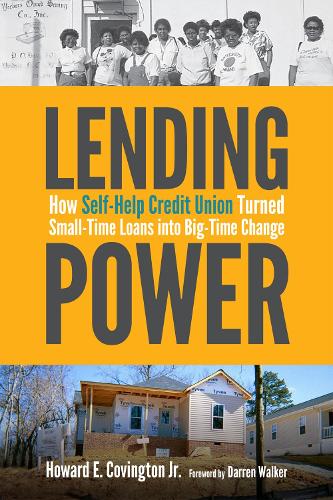
Книга Lending Power: How Self-Help Credit Union Turned Small-Time Loans into Big-Time Change
Established by Martin Eakes and Bonnie Wright in North Carolina in 1980, the nonprofit Center for Community Self-Help has grown from an innovative financial institution dedicated to civil rights into the nation's largest home lender to low- and moderate-income borrowers. Self-Help's first capital campaign—a bake sale that raised a meager seventy-seven dollars for a credit union—may not have done much to fulfill the organization's early goals of promoting worker-owned businesses, but it was a crucial first step toward wielding inclusive lending as a weapon for economic justice.
In Lending Power journalist and historian Howard E. Covington Jr. narrates the compelling story of Self-Help's founders and coworkers as they built a progressive and community-oriented financial institution. First established to assist workers displaced by closed furniture and textile mills, Self-Help created a credit union that expanded into providing home loans for those on the margins of the financial market, especially people of color and single mothers.
Using its own lending record, Self-Help convinced commercial banks to follow suit, extending its influence well beyond North Carolina. In 1999 its efforts led to the first state law against predatory lending. A decade later, as the Great Recession ravaged the nation's economy, its legislative victories helped influence the Dodd-Frank Wall Street Reform and Consumer Protection Act and the formation of the Consumer Financial Protection Bureau. Self-Help also created a federally chartered credit union to expand to California and later to Illinois and Florida, where it assisted ailing community-based credit unions and financial institutions.
Throughout its history, Self-Help has never wavered from its mission to use Dr. Martin Luther King Jr.'s vision of justice to extend economic opportunity to the nation's unbanked and underserved citizens. With nearly two billion dollars in assets, Self-Help also shows that such a model for nonprofits can be financially successful while serving the greater good. At a time when calls for economic justice are growing ever louder, Lending Power shows how hard-working and dedicated people can help improve their communities.
"Lending Power is Howard Covington’s uplifting and compelling account of a credit union that champions the underserved.... This is a positive, inspiring look at a socially conscious, soundly managed mission-driven organization." - Foreword Reviews
"The book offers important perspectives on the Great Recession mortgage crisis.... Recommended. Upper-division undergraduates through faculty."
- Choice
"The story not just of the rise of a radical credit union but also of its role in the community that shaped it, which saw it work with churches, civil rights activists, maverick philanthropists and city planners to deliver change. . . . Lively and absorbing...." - Co-Op News
"Howard Covington Jr.'s work provides an interesting and engaging description of Self-Help Credit Union and the CRL. . . . Lending Power clearly provides an excellent example of social entrepreneurship that can provide valuable lessons for anyone working to accomplish a social objective." - Business History Review
"Covington’s account of an alternative model of banking, credit, and economic empowerment thus suggests both the historical and the political imperatives of excavating the voices who have long occupied the sidelines of debates about the organization of American capitalism. In this regard, Lending Power is an important intervention." - Journal of Southern History