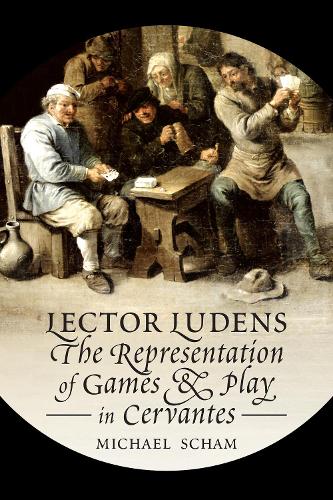
Книга 'Lector Ludens': The Representation of Games & Play in Cervantes
"Lector Ludens is an important contribution to what is known about recreation and play in the early-modern Hispanic world. Not only has Michael Scham drawn on many primary sources, both printed and archival, but he has also contextualized them within Aristotelian, scholastic, Medieval, neo-Scholastic, Erasmian, and Italian Renaissance thought. This will prove to be an invaluable tool for scholars of the period." -- Rachel Schmidt, Department of French, Italian, and Spanish, University of Calgary "Well over a half-century has passed since the publication of Johan Huizinga's Homo Ludens. In that time, not only have the games people play changed and reflected new technologies, but the boom in theory - including the development of game theory per se -has invited scholars to reexamine early modern art and society. The writings of Cervantes offer a superb bouncing-off place, given, among other things, the leisure activities of Alonso Quijano and the place of the 'idle reader' in Don Quijote. Michael Scham presents a broad approach to the topic of productive and unproductive play, with emphasis on Cervantes and his predecessors, contemporaries, and followers. The study will provide special satisfaction to those who find pleasure in 'working on' Cervantes." -- Edward H. Friedman, Department of Spanish and Portuguese, Vanderbilt University
In sixteenth- and seventeenth-century Spain, debating the acceptability of games and recreation was serious business. With Lector Ludens, Michael Scham uses Cervantes’s Don Quijote and Novelas ejemplares as the basis for a wide-ranging exploration of early modern Spanish views on recreations ranging from cards and dice to hunting, attending the theater, and reading fiction.
Shifting fluidly between modern theories of play, little-known Spanish treatises on leisure and games, and the evidence in Cervantes’s own works, Scham illuminates Cervantes’s intense fascination with games, play, and leisure, as well as the tensions in early modern Spain between the stern moralizing of the Counter-Reformation and the playfulness of Renaissance humanism.