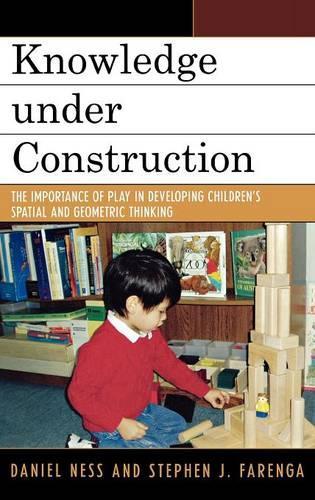
Книга Knowledge under Construction: The Importance of Play in Developing Children's Spatial and Geometric Thinking
Knowledge under Construction investigates how young children develop spatial, geometric, and scientific thinking skills-particularly those associated with architecture. Based on original research and analysis of videotapes of children's play with blocks, the authors' findings suggest that such play is anything but pointless. Their conclusions fill in gaps in our current understanding of how children learn to think spatially and scientifically even while challenging portions of that understanding, including some of Piaget's thesis about the primacy of topological space in children's learning. A system of measurement developed to identify and categorize children's spontaneous behavior at play allows adults to observe patterns of behavior as children play and record the development of process skills and cognitive abilities, enhancing our understanding of how children begin to learn about space and architectural relationships. The book also examines the educational implications of our enhanced understanding. One possible development is a new, alternative way to measure cognitive abilities and development in children based on their work with blocks.
"For preschool educators as well as interested developmental researchers, Knowledge under Construction offers a succinct, useful introduction to the topic, delineating various aspects of spatial, geometric, and architectural thinking and related theoretical perspectives that can be brought to bear on children's construction play. The book also contains helpful pedagogical features such as a set of topics and questions at the end of each chapter for discussion. Major contributions of the book are in situating this important developmental topic in natural settings (young children's spontaneous construction play) and in pointing to some promising directions regarding how this knowledge can shed light on preschool and elementary education, particularly in science and mathematics." - PsycCRITIQUES
"Daniel Ness and Stephen Farenga demonstrate that there is more going on during free play than previously presumed; specifically, they delineate emergent mathematical and scientific thinking....The unique characteristic of this book is the study of young children as architects manipulating blocks during play, and the identification of architectural principles underlying the development of spatial and geometric thinking." - Teachers College Record
"This is a fascinating book that explores how young children construct knowledge with regard to the spatial and geometric aspects of behavior during block play....The boko has a contribution to make in mathematics, early childhood education, and the field of cognitive sciences. The research is a pioneering study in an area where little data currently exists and serves as a catalyst for further investigations into the importance of play, cognitive development, and success in school." - Teaching Children Mathematics, August 2008
"Significant for educators, parents, and researchers.... These are important findings that buttress the instructional goals of the National Council of Teachers of mathematics (NCTM) for young learners.... Thought-provoking quotes and...expansive use of examples.... The authors provide insights into the implications of the research for those concerned with the education of young children. This is one of the most comprehensive works to date on the spatial, geometric, and architectural thinking of young children. Overall, this book significantly contributes to our understanding of the oftentimes overlooked mathematical abilities of our youngest learners." - American Journal of Play, Spring 2009
"This is a well-written, abundantly documented volume whose authors achieve their aim: to identify and define values and significance inherent in or related to young children's block play. This is an area of research heretofore somewhat neglected or underestimated with regard to various dimensions of the child's mathematical and scientific development. Daniel Ness and Stephen Farenga demonstrate that there is more going on during free play than previously presumed; specifically, they delineate emergent mathematical and scientific behaviors that form the basis for the development of mathematical and scientific thinking." - Teachers College Record
"The work of Ness and Farenga can meet the needs of early childhood educators by helping them understand how the everyday actions of young children in block play summon spatial characteristics and how educators can support the continued learning of young children through free play, rather than through more formal learning methods." - Childhood Education