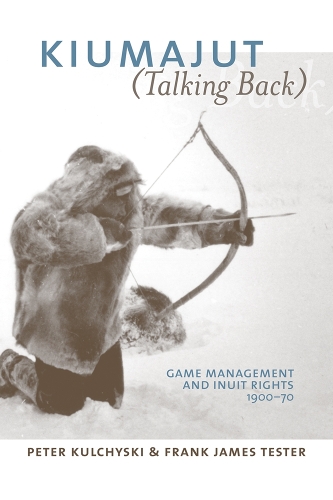
Книга Kiumajut (Talking Back): Game Management and Inuit Rights, 1900-70
The authors have documented the story with impressive thoroughness, supplementing archival and official materials with interviews with Inuit who lived through much of the period in question ... Kulchyski and Tester offer a welcome re-analysis of the events and consequences surrounding Canadian policy and practice with regard to Inuit, particularly through the mechanism of game management. The book should stimulate discussion, reaction, and further research and interpretation of crucial events in Canadian and Arctic history ... They have taken on a vast swath of northern history, immersed themselves in the available material, and emerged with a compelling account of how relations between a modern state and a hunting society were bungled with lasting consequences. -- Henry P. Huntington, Arctic, March 2008 In detail, Kiumajut presents historical data in an academic theoretical framework beyond the scope of most grade school courses. [...] It may, however, be a useful resource for Social Studies teachers wishing to deepen their understanding of Canada's twentieth-century colonial relationship with the Inuit. [...] To most of us in the south, Canada's arctic is an unknown land. Kiumajut sheds light on the modern history of the region. -- Patrik Parkes, Global Educator, The Journal for Peace and Global Educators (BCTF), Winter 2009
Kiumajut [Talking Back]: Game Management and Inuit Rights 1900-70 examines Inuit relations with the Canadian state, with a particular focus on two interrelated issues. The first is how a deeply flawed set of scientific practices for counting animal populations led policymakers to develop policies and laws intended to curtail the activities of Inuit hunters. Animal management informed by this knowledge became a justification for attempts to educate and, ultimately, to regulate Inuit hunters. The second issue is Inuit responses to the emerging regime of government intervention. The authors look closely at resulting court cases and rulings, as well as Inuit petitions. The activities of the first Inuit community council are also examined in exploring how Inuit began to “talk back” to the Canadian state.
The authors’ award-winning previous collaboration, Tammarniit [Mistakes]: Inuit Relocation in the Eastern Arctic 1939-63, focused on government responsibility, social welfare, and relocation in Inuit relations with the state. Kiumajut is not a continuation of Tammarniit, but rather an interrelated, stand-alone study that examines a separate range of issues relevant to a historical understanding of community development in Nunavut. Kiumajut draws on new material compiled from archival sources and from an archive of oral interviews conducted by the authors with Inuit elders and others between 1997 and 1999. This volume provides the reader with new and important insights for understanding this critical period in the history of Inuit in Canada.