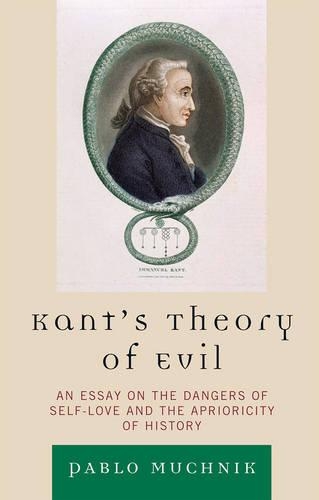
Книга Kant's Theory of Evil: An Essay on the Dangers of Self-Love and the Aprioricity of History
Kant's Theory of Evil: An Essay on The Dangers of Self-Love and the Aprioricity of History presents a novel interpretation and defense of Kant's theory of evil. Pablo Muchnik argues that this theory stems from Kant's attempt to reconcile two parallel lines of thought in his own writings: on the one hand, a philosophy of history of Rousseauian inspiration and naturalistic tendencies; on the other, the metaphysical project of founding morality exclusively on a priori grounds. The syncretism of Kant's view, as exemplified by the resulting moral anthropology in Religion within the Limits of Mere Reason, explains its persistent allure and elusiveness among Kantian readers. Muchnik's reconstruction solves some of the most intractable problems surrounding Kant's position, and is designed to break the deadlock existing between contemporary rival schools of interpretation, torn between Kant's naturalistic tendencies and his moral individualism. The "quasi-transcendental" conceptual apparatus presented in these pages will open up new paths of investigation in Kant, and influence the way we approach the problem of evil in general.
"Kant's Theory of Evil is a rich and stimulating work that directly confronts some of the most important and intractable problems of Kant's ethics and moral psychology. Muchnik is undoubtedly right in claiming that in his later work, Kant is searching for a way of addressing the first-person experience of human life that is neither a form of naturalistic psychology nor just a part of a pure metaphysics of rational agency. Kant never quite figured out how to square this circle, but Kant's Theory of Evil offers a promising account of how, from basic Kantian insights, we might go on to do so." - Notre Dame Philosophical Reviews
"Strongly recommend Muchnik's Kant's Theory of Evil. It is written with a sort of panache that is rarely found in contemporary philosophical scholarship. Throughout, there is a robust engagement with recent secondary literature and Muchnik confronts many of the most difficult problems in Kant's practical philosophy with courage and originality." - Kantian Review